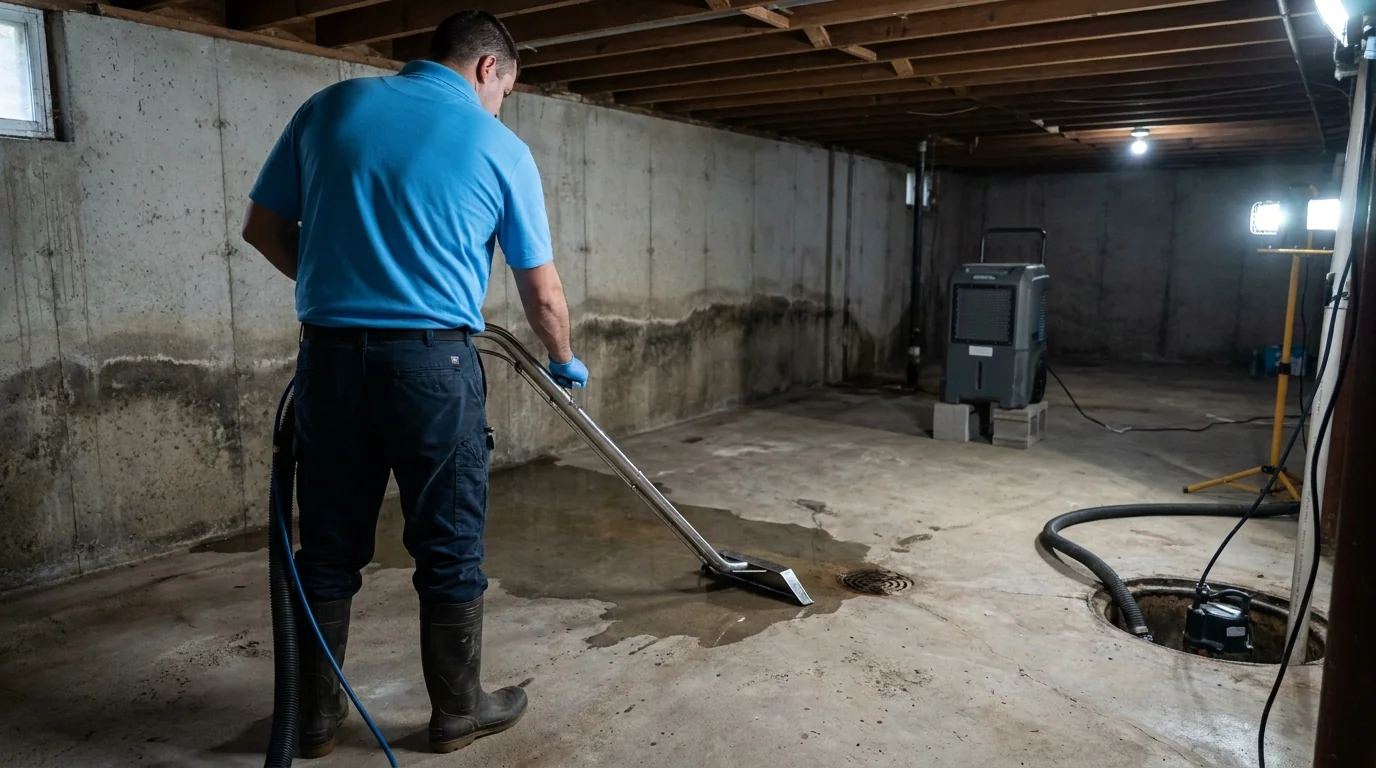
Basement Flooding Cleanup in Kenilworth
24/7 basement flooding cleanup in Kenilworth, NJ. IICRC-certified, insurance billing accepted. Call (908) 970-8533.
Our IICRC-certified technicians are dispatched from our Fair Lawn, NJ headquarters and are typically on-site in Kenilworth within 60 minutes of your call.
When Black Brook’s storm drains overwhelm during a heavy cloudburst — the kind that turned basements across Kenilworth into wading pools during Ida in September 2021 — there’s rarely a slow buildup. One hour the sump pit is dry; the next, water is lapping at the base of your water heater. Our headquarters sits on S 31st Street, less than a mile from most of the borough’s residential streets, which means when a flooded basement call comes in from 07033, we’re loading equipment while other contractors are still mapping the route.
Why Kenilworth Properties See Basement Flooding So Often
Kenilworth is a square-mile borough built out almost entirely between the 1920s and 1950s. That era of construction means full, poured-concrete or block basements under nearly every cape and colonial — which is good for storage and living space, but creates real vulnerability when the waterproofing systems age out. Galvanized supply lines that have been narrowing with mineral buildup for sixty or seventy years can fail without warning. Clay sewer laterals, common throughout the older housing stock in North Kenilworth and along the Boulevard corridor, crack under root intrusion and ground shift, sending sewage back up through floor drains. Sump pumps in these homes often date to the 1990s or earlier; a single power outage during a storm is enough to let groundwater rise through the slab.
Black Brook itself runs through the borough and feeds a network of storm drains that were engineered for rain events typical of mid-century Union County — not the increasingly intense cloudbursts the region has seen in recent years. When the system backs up, water finds the path of least resistance: through window wells, through foundation cracks, through the gap where an old oil-fill pipe was capped but never sealed properly.
Our Basement Flooding Cleanup Process in Kenilworth
The first thing we do when we arrive is identify the water category — clean supply-line water, gray water from an appliance or laundry line, or black water from a sewer backup. That classification drives every decision that follows, from whether we can use the existing floor drain for extraction to how aggressively we need to treat the affected surfaces before drying begins.
For a typical flooded basement in a Kenilworth cape or colonial, the process runs like this:
- Water extraction: Truck-mounted or portable extractors pull standing water from concrete floors and, where present, from carpet or vinyl tile that’s absorbed the flood. We check beneath any subfloor framing for trapped water — common in finished basement additions on these older homes.
- Material assessment: Fiberglass batt insulation in block-wall cavities holds water like a sponge and almost always needs to come out. Drywall below the flood line is evaluated by moisture meter, not by eye — walls can look dry and read 40% moisture content.
- Structural drying: We place industrial desiccant or refrigerant dehumidifiers and high-velocity air movers calibrated to the room volume. Drying logs are recorded daily and shared with your insurance adjuster.
- Antimicrobial treatment: Applied to concrete, framing, and any surface that contacted gray or black water. Mold colonization can begin within 24 to 48 hours in a damp basement — we don’t leave that window open.
Because we’re IICRC Certified (Firm #210213), the drying protocol follows the S500 standard, which gives your insurance carrier a documented, defensible record of every step.
Insurance Coordination for Kenilworth Homeowners
Most standard homeowners policies in New Jersey cover sudden and accidental water damage — a burst pipe, a failed water heater, an appliance supply line that lets go — but exclude gradual seepage and flooding from outside the home unless you carry separate flood coverage. That distinction matters enormously in Kenilworth, where a single storm event can produce both: Black Brook overflow pushing water in through the foundation wall (often not covered) and a sump pump burning out under the load (often covered as equipment failure).
We document both mechanisms separately when both are present, photograph the water line, the source, and the affected materials, and communicate directly with your adjuster so the covered portion of the loss moves through the claim efficiently. We’re a licensed NJ Home Improvement Contractor under the Division of Consumer Affairs, so our estimates carry the documentation format carriers expect.
Local Note
One thing that comes up specifically in Kenilworth’s prewar capes and colonials: many of these homes were finished in the basement at some point in the 1970s or 1980s using wood-paneled walls furred out from the block foundation. When water gets behind that furring, it sits against the block and the wood framing for days before anyone notices the paneling is soft. By the time the visible damage is obvious, the block cavity is often already growing mold. If your basement has that older paneled finish and you’ve had any water event — even one that seemed minor — it’s worth having the moisture levels behind the walls checked before the next wet season. We carry thermal imaging equipment that can flag elevated moisture through a finished wall without cutting into it.
If you’re dealing with a flooded basement anywhere in Kenilworth — whether it’s a sump failure in North Kenilworth, a sewer backup near the Black Brook Park corridor, or a burst pipe in a finished lower level — call (908) 970-8533 any hour. We’re already close.
Basement Flooding Cleanup in Kenilworth: Service Coverage
Frequently Asked Questions
How fast can you arrive for basement flooding cleanup in Kenilworth?
How quickly can The Restoration Group reach a flooded basement in Kenilworth's North Kenilworth or Boulevard corridor neighborhoods?
Kenilworth has a lot of older homes with clay sewer laterals — does a sewage backup in the basement require different cleanup than a regular flood?
My basement flooded during a storm like Ida — will my homeowners insurance cover the cleanup in Kenilworth?
What happens if the water got behind the wood-paneled walls in my finished Kenilworth basement?
How long does basement drying typically take in a Kenilworth home after a flood?
Basement Flooding Cleanup response in Kenilworth
Most Kenilworth calls see a technician on-site within 60 minutes from our Fair Lawn headquarters.