Water Damage Restoration in Manhattan
24/7 water damage restoration in Manhattan, NY. IICRC-certified, insurance billing accepted. Call (908) 970-8533.
Our IICRC-certified technicians are dispatched from our Fair Lawn, NJ headquarters and are typically on-site in Manhattan within 60 minutes of your call.
When a radiator valve fails on the 14th floor of a pre-war co-op on the Upper East Side, the water doesn’t stop at one unit — it travels through plaster, lath, and century-old pipe chases until ceilings on floors below are sagging and stained. Manhattan water damage moves vertically and fast, and the window between a contained loss and a multi-unit claim is measured in hours, not days. The Restoration Group responds 24/7, bringing IICRC-certified structural drying and water extraction to buildings across the borough — from Financial District high-rises to walk-up apartments in Harlem.
Why Manhattan Properties See Water Damage Differently
The borough’s building stock creates conditions that don’t exist in most other markets. Pre-war co-ops and condos — the kind that line the blocks between Central Park and the East River — were built with thick plaster walls and horsehair insulation that absorb water slowly but release it even more slowly. A leak that soaks modern drywall in hours can stay hidden inside plaster for days, with moisture migrating laterally through wall cavities before it ever shows on a surface reading.
Aging riser pipes, steam heating systems, and building-wide water mains are the most common culprits in older residential towers. In newer Midtown and Chelsea developments, washing-machine supply lines and HVAC condensate drains account for a significant share of losses. Then there’s the weather: Tropical Storm Ida overwhelmed the city’s storm drains in 2021, sending water into basement apartments and below-grade retail from Harlem to Chelsea in a matter of minutes. The Financial District and Lower East Side still carry the institutional memory of Hurricane Sandy’s surge — and building managers in those ZIP codes (10002, 10038) know exactly how quickly a drainage failure becomes a six-figure loss.
Our Water Damage Restoration Process in Manhattan
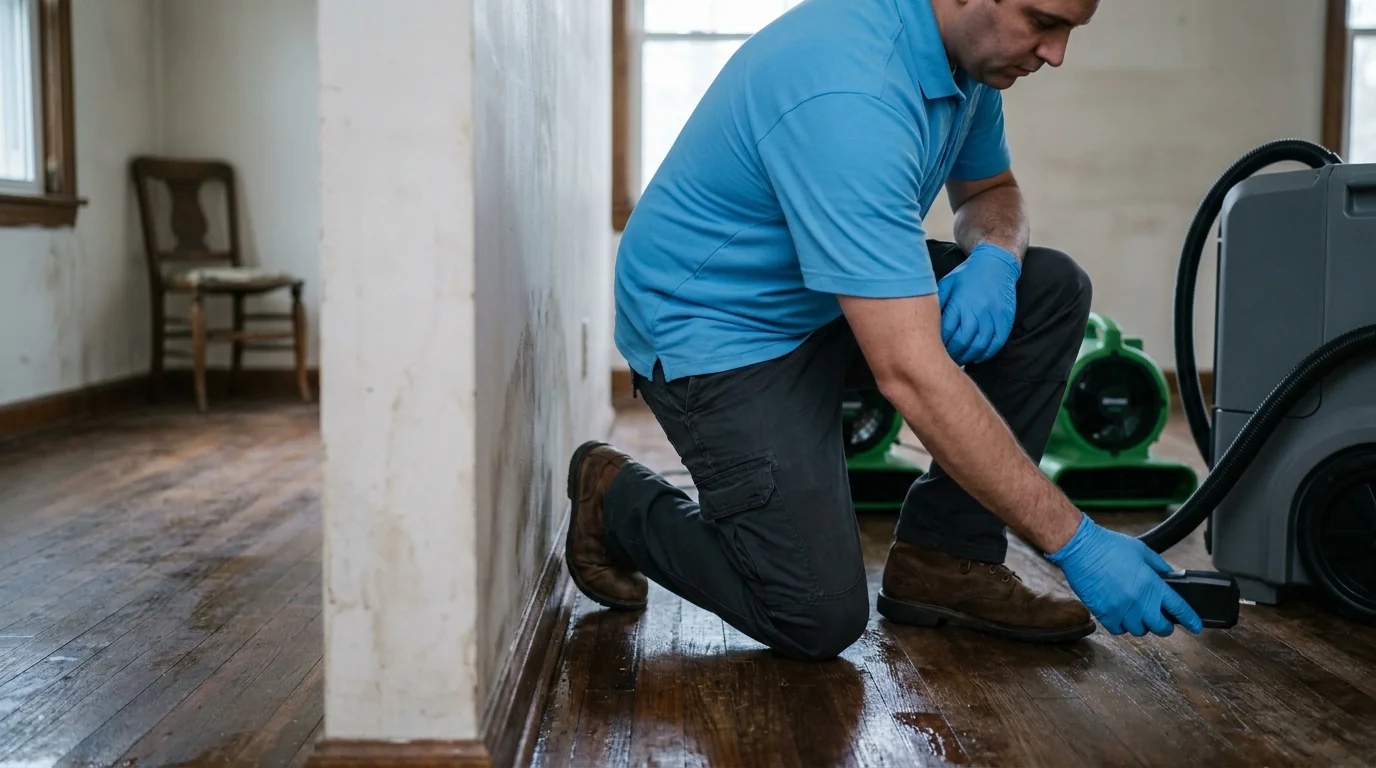
Every job starts with a moisture mapping survey — thermal imaging and calibrated meters across every affected surface, including ceilings below the source floor and adjacent walls. In a multi-unit building, that means logging readings unit by unit and producing documentation that the resident manager, board, and managing agent can actually use.
Once the scope is confirmed, standing water is removed with truck-mounted and portable extraction equipment sized for the access constraints of Manhattan buildings — freight elevator schedules, narrow hallways, and no-parking loading zones all factor into how we stage equipment. Structural drying follows the IICRC S500 standard: commercial-grade desiccant or refrigerant dehumidifiers and high-velocity air movers placed according to a calculated drying plan, not guesswork. We monitor and log readings daily until affected materials reach target moisture levels, then provide a written drying report — the kind of documentation that satisfies both insurance adjusters and co-op boards.
For commercial losses — restaurant kitchens, retail floors, office suites — we schedule the most disruptive work overnight to limit business interruption. Every closed day in a Manhattan commercial space is measurable lost revenue, and we build the mitigation timeline around that reality.
Reaching Manhattan from Kenilworth
The Restoration Group is based in Kenilworth, NJ, with direct access to the Lincoln Tunnel and the Holland Tunnel — two of the fastest cross-Hudson routes into Midtown and Lower Manhattan respectively. Because we operate around the clock, we can dispatch crews at hours when tunnel traffic is lightest, which matters when a pipe bursts at 2 a.m. in a building near Grand Central Terminal or a basement floods in the Financial District before the morning commute.
We maintain working relationships with freight elevator coordinators at buildings across the borough and know the loading dock and service entrance protocols that slow down contractors who don’t work here regularly. That familiarity shortens setup time on-site — which shortens drying time overall.
Manhattan Insurance and Building Coordination
Water losses in Manhattan almost always involve more than one party: the unit owner, the building’s master policy, a managing agent, and sometimes a neighbor’s insurer. We document losses with photographs, moisture logs, and scope-of-work reports formatted to meet the requirements of major commercial and residential carriers. We bill insurance directly where coverage applies, so property owners are not fronting the full mitigation cost out of pocket.
Co-op boards and condo associations in buildings across the Upper West Side and Midtown typically require certificates of insurance before any contractor accesses common areas or service elevators. We carry the coverage those buildings require and can provide documentation before crews arrive.
Local Note
One thing that catches out-of-market contractors in Manhattan: the plaster walls common in pre-war buildings (roughly anything built before 1950) read differently on a moisture meter than modern drywall does. Plaster has a higher baseline density, so a meter calibrated for gypsum board will underread moisture content in a plaster wall — sometimes significantly. We use reference readings taken from confirmed-dry sections of the same wall to calibrate our instruments for each building’s specific material, which means our drying targets are accurate rather than optimistic. Declaring a plaster wall dry before it actually is leads to mold colonization inside the wall cavity — typically within 48 to 72 hours in a heated Manhattan apartment — and a second remediation job nobody wanted.
If you’re dealing with water damage anywhere in Manhattan — a burst pipe, an appliance failure, storm flooding, or a leak from the unit above — call (908) 970-8533 now. The Restoration Group’s certified team is available 24/7 to extract water, dry the structure, and produce the documentation your building and your insurer need to close the claim.
Water Damage Restoration in Manhattan: Service Coverage
Frequently Asked Questions
How fast can you arrive for water damage restoration in Manhattan?
How quickly can The Restoration Group reach a water damage emergency in Midtown or the Financial District?
A pipe failed two floors above my Upper East Side co-op unit and water came through my ceiling. Who is responsible, and how does the claim process work?
Do Manhattan co-op and condo buildings have specific requirements that affect how water damage work gets done?
How long does structural drying typically take in a pre-war Manhattan apartment with plaster walls?
Can storm or sewer backup flooding in a ZIP code like 10002 or 10038 be covered by standard homeowner's or renter's insurance?
Water Damage Restoration response in Manhattan
Most Manhattan calls see a technician on-site within 60 minutes from our Fair Lawn headquarters.