Water Damage Restoration in Newark
24/7 water damage restoration in Newark, NJ. IICRC-certified, insurance billing accepted. Call (908) 970-8533.
Our IICRC-certified technicians are dispatched from our Fair Lawn, NJ headquarters and are typically on-site in Newark within 60 minutes of your call.
When a pipe lets go on the third floor of a Ironbound three-family, the water doesn’t stop at the unit where it started — it follows the framing down through two more floors before anyone notices the ceiling bubbling in the ground-floor apartment. Newark’s dense pre-war housing stock turns what might be a contained incident in a newer suburb into a multi-unit emergency within minutes. The Restoration Group responds 24/7 from Kenilworth, reaching most Newark neighborhoods in under half an hour, ready to stop the spread before the damage compounds.
Why Newark Properties See Water Damage Differently
Newark’s geography and infrastructure create a specific set of conditions that restoration crews have to account for before they pull a single piece of equipment off the truck.
The Ironbound district sits in a natural low point along the Passaic River. During Tropical Storm Ida, that geography turned streets into channels and pushed water into basements faster than sump pumps could cycle. But the flooding risk isn’t limited to named storms. Newark’s combined sewer system — where stormwater and sanitary sewage share the same pipes — backs up into basement drains during any sustained heavy rain. That means a significant portion of Newark water damage calls involve Category 3 contaminated water, not clean supply-line failures. The cleanup protocol for sewage-contaminated water is substantially more involved: affected materials are treated as biohazardous, and affected areas require antimicrobial treatment before any drying equipment is staged.
The housing stock adds another layer. Brick multifamily buildings and the grand colonials in Forest Hill were built before 1950, when wall cavities were filled with horsehair plaster, wood lath, and sometimes vermiculite insulation. These materials absorb and hold moisture differently than modern drywall — extraction is faster in some ways, but the drying phase can run significantly longer because older assemblies release moisture slowly and unevenly. Moisture meters and thermal imaging cameras are essential here; what looks dry on the surface is often still saturated two inches in.
For landlords managing buildings near Newark Penn Station or property managers overseeing institutional accounts in University Heights, there’s an added pressure: tenants can’t be displaced indefinitely, and documentation for insurance carriers needs to be airtight from day one.
Our Water Damage Restoration Process in Newark
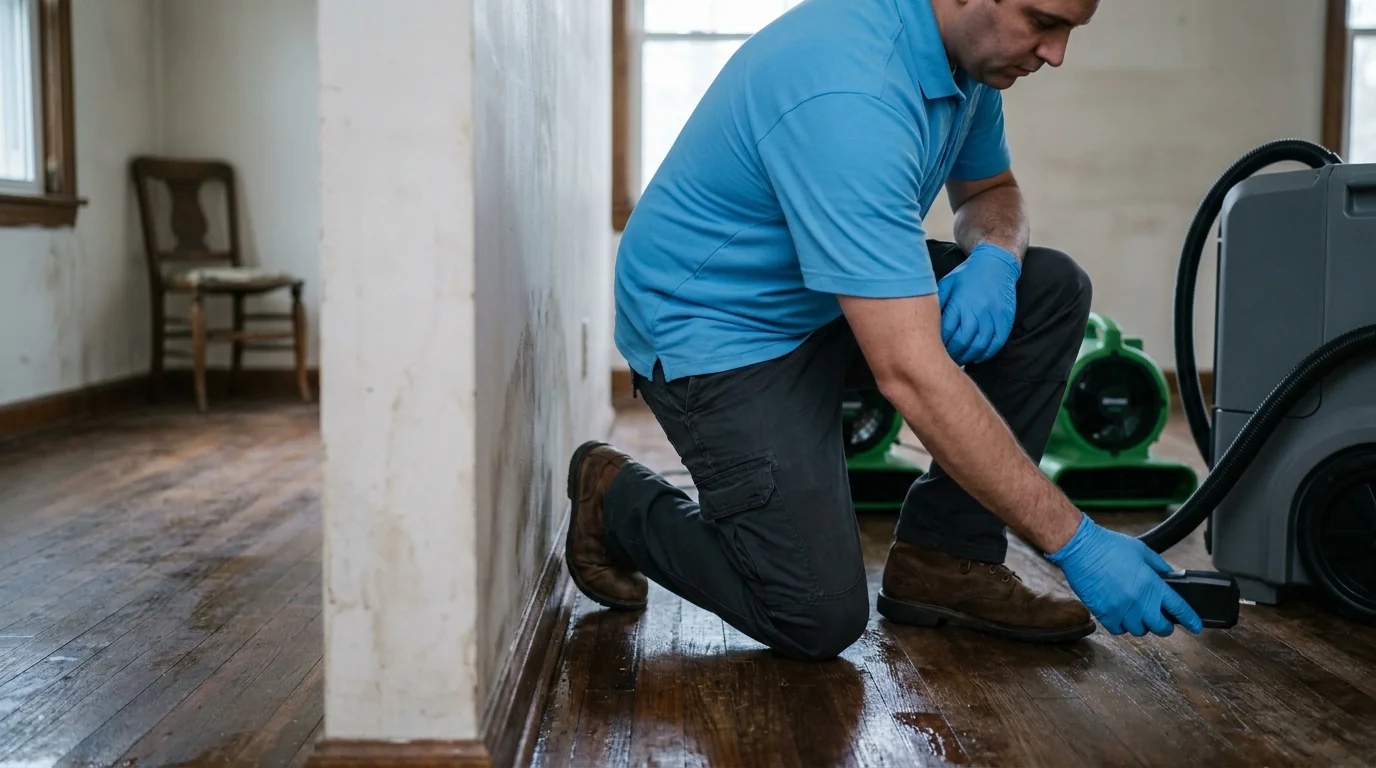
Every job starts with a thorough inspection using thermal imaging and calibrated moisture meters to map exactly where water has traveled — not just where it’s visible. In Newark’s older multi-unit buildings, water routinely migrates through shared walls, beneath tile, and inside plumbing chases before it shows up as a stain.
Water extraction comes next. Truck-mounted and portable extraction units pull standing water from floors, subfloors, and carpet. In basement flooding situations common to the Ironbound and Weequahic, we address any sewage contamination before extraction begins, following IICRC S500 protocols for Category 3 water.
Structural drying is set up with industrial air movers and refrigerant or desiccant dehumidifiers sized to the affected square footage — not a one-size setup. Drying logs are recorded daily and shared with the property owner and their insurance adjuster. In Newark’s brick construction, drying timelines are monitored closely because masonry retains moisture longer than wood-frame walls.
Demolition of unsalvageable material — wet drywall, saturated insulation, buckled flooring — is handled carefully in pre-1978 buildings where lead paint and asbestos-containing materials are a real possibility. As an IICRC Certified Firm (#210213) and NJ Licensed Home Improvement Contractor, we follow applicable state guidelines and can coordinate testing when indicated.
Final clearance moisture readings are documented before any reconstruction begins.
Reaching Newark from Kenilworth
Kenilworth sits roughly fifteen minutes from Newark via the Garden State Parkway or Route 22 to McCarter Highway. Because we run 24/7 operations, that drive time holds up at 2 a.m. as reliably as it does at 2 p.m. — there’s no waiting until morning for a crew to mobilize.
For addresses in the 07105 ZIP code covering the Ironbound, or properties near Branch Brook Park in the North Ward, we’re typically on-site well within the window where the difference between prompt extraction and delayed response starts showing up in the scope of damage. Every hour of standing water in a wood-subfloor building is an hour closer to secondary mold colonization, which IICRC guidance places at 24–48 hours in warm, humid conditions — conditions Newark summers reliably provide.
Newark Insurance & Documentation
Most Newark water damage claims run through standard homeowners or landlord policies, but the documentation requirements can vary significantly depending on whether the loss involves sewage backup (often a separate rider), a riser failure in a multifamily building (which may involve multiple unit claims), or storm-related flooding. We photograph and document affected materials before anything is removed, generate moisture-mapping reports, and communicate directly with adjusters to keep the claim moving. Landlords managing multiple units in a single building — a common scenario in Newark — can consolidate documentation through us rather than coordinating separately with each tenant’s carrier.
Local Note
In Newark’s older multifamily buildings, particularly the brick three-families common throughout Vailsburg and the Ironbound, the original cast-iron drain stacks can develop pinhole failures or joint separations that go unnoticed for months — slow leaks that saturate the framing inside a wall cavity long before water appears on a finished surface. By the time a tenant notices a soft spot in the floor or a musty smell, the damage is often behind the walls across two or three floors. When we get a call that starts with “I’m not sure where the water is coming from,” that’s frequently what we find. Thermal imaging on the first pass almost always tells the story faster than any visible inspection.
If you’re dealing with water damage anywhere in Newark — whether it’s a burst riser in a Downtown Newark high-rise, a backed-up basement drain in Weequahic, or a slow leak that’s been working on a Forest Hill colonial’s plaster walls for weeks — call The Restoration Group at (908) 970-8533. We’re available around the clock, and we’ll have a crew moving toward you before you hang up.
Water Damage Restoration in Newark: Service Coverage
Frequently Asked Questions
How fast can you arrive for water damage restoration in Newark?
How quickly can The Restoration Group reach the Ironbound or other Newark neighborhoods from Kenilworth?
Newark's combined sewers back up into basements during heavy rain — does that change how water damage cleanup works?
Are the older brick and plaster buildings common in Forest Hill and Vailsburg harder to dry out after water damage?
What should Newark landlords or property managers do when a riser failure floods multiple units in one building?
How long does structural drying typically take for a water-damaged Newark home, and what equipment is involved?
Will my homeowners insurance cover water damage restoration in Newark?
Water Damage Restoration response in Newark
Most Newark calls see a technician on-site within 60 minutes from our Fair Lawn headquarters.