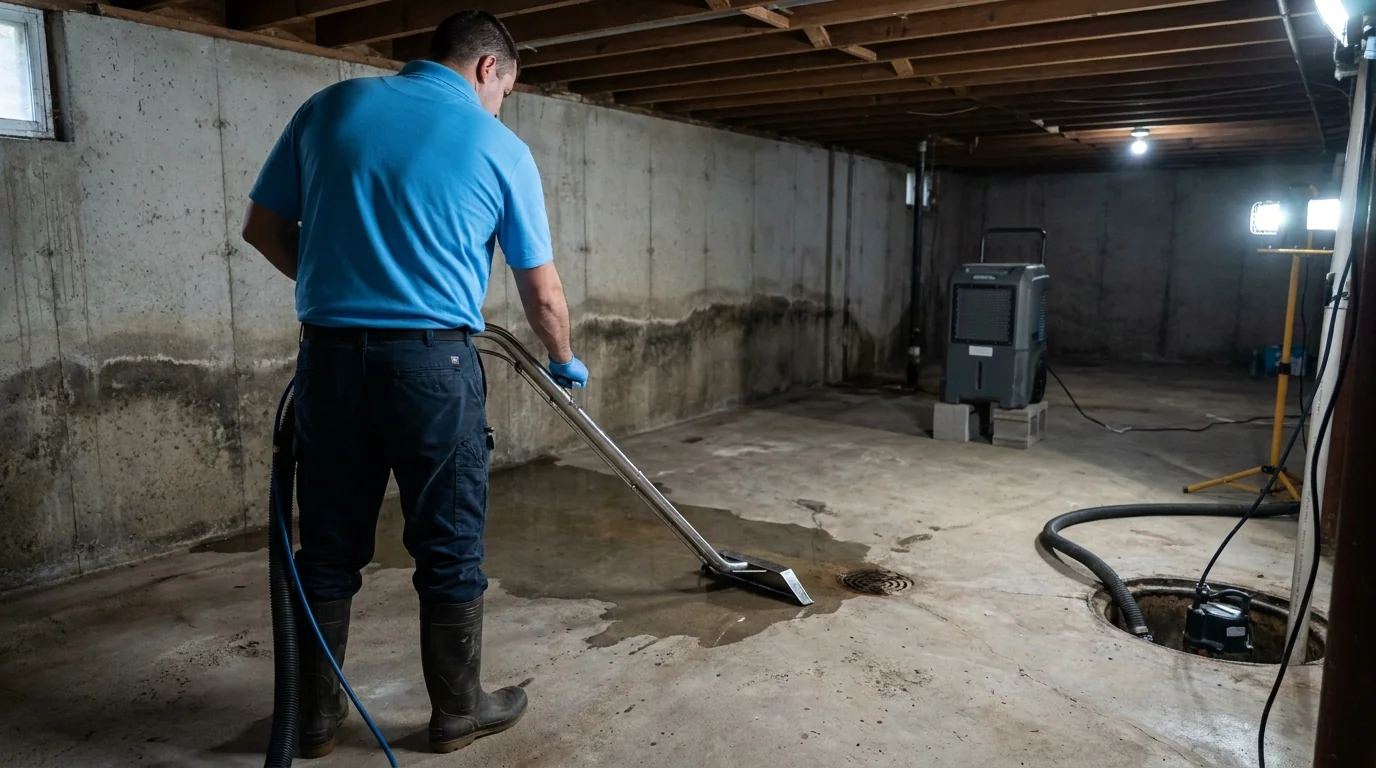
Basement Flooding Cleanup in Summit
24/7 basement flooding cleanup in Summit, NJ. IICRC-certified, insurance billing accepted. Call (908) 970-8533.
Our IICRC-certified technicians are dispatched from our Fair Lawn, NJ headquarters and are typically on-site in Summit within 60 minutes of your call.
Summit’s steep hillside lots and century-old housing stock create a basement flooding pattern that’s unlike anything you’d find in the flatter towns to the east. When a clay sewer lateral backs up beneath a 1910 Colonial near the Franklin School area, or a supply line bursts inside an uninsulated wall during a January freeze, the water doesn’t just sit on a concrete slab — it soaks into original plaster, wicks up into heart-pine framing, and threatens the kind of built-in millwork and hardwood flooring that simply cannot be replaced with a box-store equivalent. The Restoration Group responds 24/7 to flooded basements throughout Summit, ZIP code 07901, with the equipment and care that high-value older homes demand.
Why Summit Basements Flood Differently Than Neighboring Towns
Elevation protects Summit from the riverine flooding that routinely hits Millburn and Springfield, but it creates its own drainage problem. Stormwater that falls on Summit’s upper streets has to go somewhere, and on lots with steep grades — common in the Northside and in the blocks surrounding Reeves-Reed Arboretum — that water channels hard against foundation walls. Original rubble-stone and early poured-concrete foundations from the 1890s–1930s were not built with modern waterproofing membranes; they depend on functional exterior drainage that often hasn’t been serviced in decades.
Inside the house, aging galvanized supply lines and original cast-iron drain stacks corrode from the inside out. Radiator feed lines routed through unheated crawl spaces or exterior walls — common in the large multi-wing homes along the Springfield Avenue corridor — are the first to fail during a hard freeze. And Summit’s mature street tree canopy, while beautiful, sends roots directly into clay sewer laterals, causing backups that push sewage-contaminated water up through basement floor drains with almost no warning.
Our Basement Water Removal and Drying Process in Summit
When we arrive, the first priority is stopping the source — whether that means helping you locate the main shutoff on a burst pipe or confirming with you that a sewer backup has been isolated. From there, the work follows a disciplined sequence calibrated to the conditions we consistently find in Summit homes.
Water extraction begins with truck-mounted and portable extractors capable of pulling standing water from finished basement spaces without damaging hardwood flooring or area rugs. We move furnishings carefully and document their condition before touching them — the antiques and period pieces common in Summit households deserve the same attention as the structure itself.
Moisture mapping comes next. We use thermal imaging cameras and calibrated moisture meters to trace water migration into plaster walls, behind wainscoting, and beneath subfloors. In a house built before 1940, water travels farther and hides better than in modern construction, so we don’t assume the wet zone ends where the visible damage does.
Structural drying uses industrial air movers and low-grain refrigerant dehumidifiers positioned according to the IICRC S500 standard for water damage drying. Drying goals are set based on material type and baseline humidity readings — not a fixed number of days.
Content handling is coordinated throughout. Salvageable items are moved to a dry area of the home or packed out for off-site cleaning and storage when the basement needs to remain a work zone.
Reaching Summit from Our Kenilworth Location
Our Kenilworth headquarters puts us on Route 22 within minutes, with straightforward access to Summit via the Garden State Parkway to Route 512 or directly through Springfield and New Providence. Because we operate around the clock, we can be on-site in Summit at 2 a.m. on a Tuesday the same way we can on a Saturday afternoon. When you call (908) 970-8533, a live dispatcher — not an answering service — takes the details and gets a crew moving.
Insurance Coordination for Summit Homeowners
Basement flooding claims in Summit frequently involve questions about whether the loss is covered under standard homeowners policies (sudden and accidental discharge, like a burst pipe) versus what’s typically excluded (gradual seepage, sewer backup without a rider). We document the loss thoroughly from the moment we arrive — photographs, moisture readings, written scope — and provide your adjuster with the organized file they need to process the claim. We bill carriers directly for covered losses, which means you are not writing a large check and waiting for reimbursement.
Local Note
In Summit’s older finished basements, we frequently encounter original plaster on the lower walls — sometimes down to the floor — rather than the drywall you’d find in a post-1980 home. Plaster absorbs water more slowly than drywall, which sounds like an advantage, but it also releases that moisture slowly during drying. We’ve found that drying times in these spaces run roughly 30–40% longer than our equipment’s baseline projections for the same square footage in modern construction. We account for this upfront when we set drying goals and communicate the timeline to homeowners and adjusters, rather than discovering it mid-job and extending the schedule unexpectedly.
If your Summit basement is holding water right now — or you’ve just found damp walls and a musty smell that wasn’t there last week — call (908) 970-8533. We’ll assess the situation, explain what we’re seeing in plain language, and get the drying process started before secondary damage compounds the loss.
Basement Flooding Cleanup in Summit: Service Coverage
Frequently Asked Questions
How fast can you arrive for basement flooding cleanup in Summit?
Are homes in Summit's Northside and Franklin School area more prone to sewer backup flooding than other parts of town?
How does Summit's older housing stock affect the basement drying timeline?
Can you handle high-value contents — antiques, built-ins, period millwork — during a basement flooding cleanup in Summit?
What's the difference between a covered burst-pipe claim and a non-covered seepage claim for Summit homeowners?
Do freeze events near the Summit train station area cause a particular type of pipe failure you see often?
Will my homeowners insurance cover basement flooding cleanup in Summit?
Basement Flooding Cleanup response in Summit
Most Summit calls see a technician on-site within 60 minutes from our Fair Lawn headquarters.