Emergency Board-Up and Tarping in Manhattan
24/7 emergency board-up and tarping in Manhattan, NY. IICRC-certified, insurance billing accepted. Call (908) 970-8533.
Our IICRC-certified technicians are dispatched from our Fair Lawn, NJ headquarters and are typically on-site in Manhattan within 60 minutes of your call.
When a fire tears through a Chelsea brownstone or a storm peels back flashing on a pre-war co-op in the Upper West Side, the window between the initial damage and the next wave of loss — rain, theft, curious bystanders — can be measured in hours. Emergency board-up and tarping in Manhattan isn’t just about nailing plywood over an opening; it’s about navigating freight elevators, building management protocols, and a density of neighboring properties that means an unsecured opening on the fourth floor affects everyone below and beside it. The Restoration Group responds 24/7, bringing the materials and the borough-specific know-how to secure your property before conditions worsen.
Why Manhattan Properties Face Distinct Board-Up and Tarping Challenges
Manhattan’s building stock is unlike anywhere else in the country. Pre-war co-ops from the 1910s and 1920s — common from the Upper East Side through Harlem — were built with terra cotta block, thick plaster, and ornate cornices that complicate both roof access and exterior anchoring. A tarp that would stake cleanly into suburban soil here has to be weighted, clamped, or tied to parapet walls without violating landmark or co-op board rules.
The borough’s vertical nature compounds every emergency. Superstorm Sandy’s surge devastated the Financial District and the Lower East Side; Hurricane Ida overwhelmed storm drains from Harlem to Chelsea in a matter of hours. When a roof membrane fails or a window blows out during a nor’easter, the exposure isn’t just one unit — it’s every floor below the breach. Retail and restaurant interiors along Midtown corridors face an additional clock: every hour the storefront sits open is revenue walking out the door.
New York City’s building code also requires that any exterior protective work on a structure above a public sidewalk include a licensed contractor and, in many cases, a sidewalk shed or protective canopy. We carry the certificates of insurance that resident managers and managing agents require before any crew sets foot in a common area, and we coordinate directly with building staff so work moves without stalling your board’s approval process.
Our Emergency Board-Up and Tarping Process in Manhattan
When you call, a crew is dispatched immediately — 24 hours a day, seven days a week. Here’s what the response looks like on the ground:
Assessment and site coordination. On arrival, the crew lead contacts the building’s superintendent or managing agent to confirm freight elevator availability, after-hours access protocols, and any board-mandated documentation requirements. In a high-rise, this step alone can determine whether materials reach the affected floor in twenty minutes or two hours — we build it into our timeline, not around it.
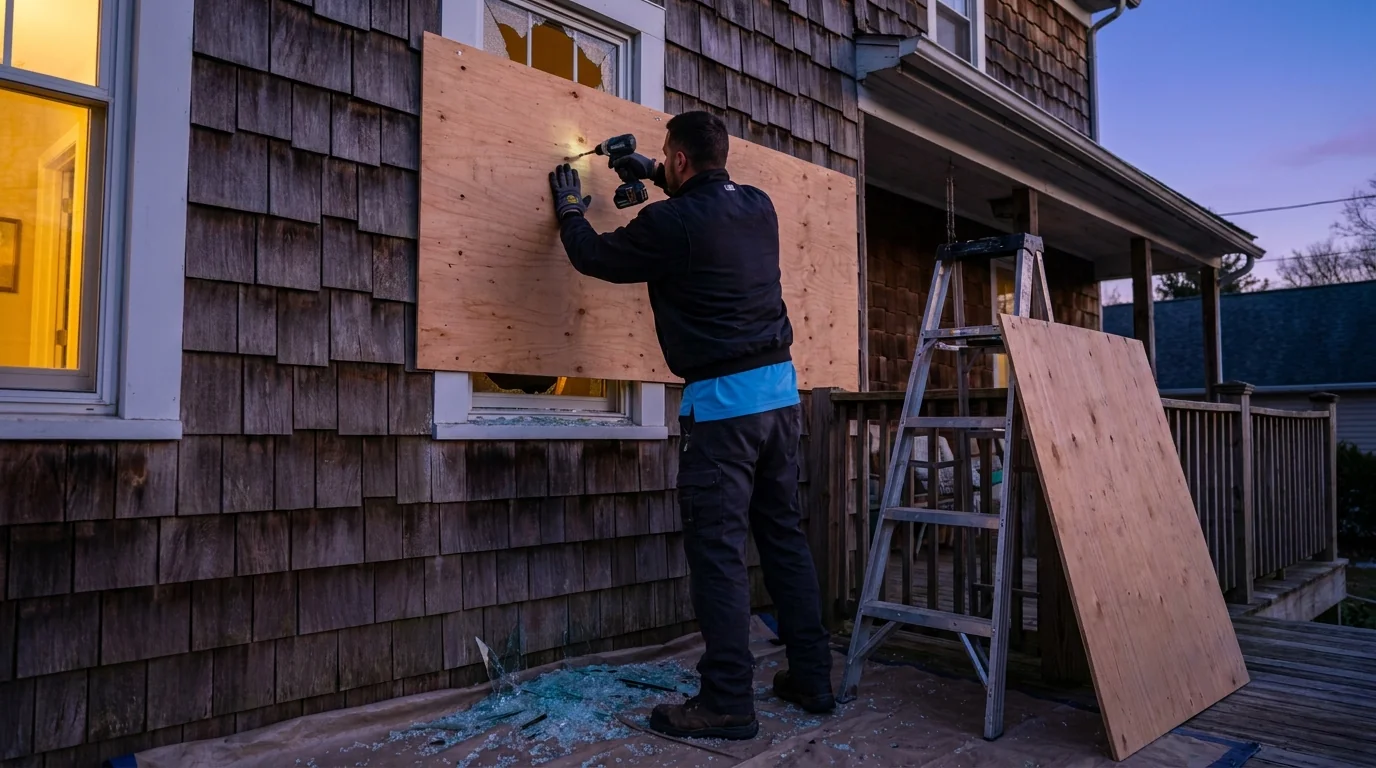
Structural opening security. Fire-damaged windows, doors, and wall breaches are measured and boarded with 3/4-inch plywood, fastened in a way that meets NYC Buildings Department temporary protection standards. For ground-floor commercial spaces in areas like the Financial District (ZIP code 10038), we use steel security panels when the risk of forced entry is elevated.
Roof tarping. Heavy-duty polyethylene tarps — minimum 6-mil, typically reinforced poly — are secured over damaged roof sections using weighted ballast and parapet tie-offs appropriate for flat Manhattan rooftops. Pitched roofs on townhouses in Chelsea or the West Village get ridge-line anchoring to prevent wind lift during subsequent storm events.
Documentation. Every opening is photographed before and after boarding. We provide a written scope of work and a moisture baseline reading to the property owner and, where applicable, to the managing agent — the kind of unit-by-unit record that co-op boards and insurance adjusters both expect.
Reaching Manhattan from Kenilworth
The Restoration Group is based in Kenilworth, NJ, with direct access to the Lincoln Tunnel and the Holland Tunnel, putting crews into Midtown, Chelsea, and the Financial District without the routing delays that affect teams coming from outer boroughs. Because we operate around the clock, dispatch happens the moment you call — not at the start of the next business day. Travel time varies with traffic and the specific neighborhood, but our 24/7 availability means no job waits until morning.
Manhattan Insurance and Building Management Coordination
Most Manhattan losses touch more than one party: the unit owner, the co-op or condo board, the managing agent, and one or more insurance carriers. We document damage with the level of detail that adjusters require — itemized photos, moisture readings, and a written scope — and we communicate directly with your carrier’s claims team when you authorize us to do so. If your building’s board requires a certificate of insurance before work begins, we have that ready before the crew arrives.
Local Note
In Manhattan’s older co-op buildings — particularly the pre-war towers along Central Park West and the Upper East Side — window frames are often set in masonry without a standard rough opening. Standard plywood board-up hardware won’t anchor cleanly into those surrounds without risking damage to historic millwork or triggering a board violation. Our crews carry masonry anchors, foam backer rod, and friction-fit panel systems specifically for these situations, so the opening is secured without creating a secondary repair problem.
If your Manhattan property has been damaged by fire, storm, or a structural breach, call The Restoration Group at (908) 970-8533. We’ll secure the building, document the loss, and coordinate with whoever needs to be in the loop — day or night.
Emergency Board-Up and Tarping in Manhattan: Service Coverage
Frequently Asked Questions
How fast can you arrive for emergency board-up and tarping in Manhattan?
Can you reach the Upper East Side or Upper West Side quickly enough to prevent further damage overnight?
How does Manhattan's co-op board process affect emergency board-up work?
What type of board-up materials do you use on Manhattan's pre-war masonry buildings?
Does New York City require anything specific for temporary board-up or tarping work above a public sidewalk?
How long does emergency tarping on a Manhattan flat roof typically hold before permanent repairs are needed?
Will my homeowners insurance cover emergency board-up and tarping in Manhattan?
Emergency Board-Up and Tarping response in Manhattan
Most Manhattan calls see a technician on-site within 60 minutes from our Fair Lawn headquarters.