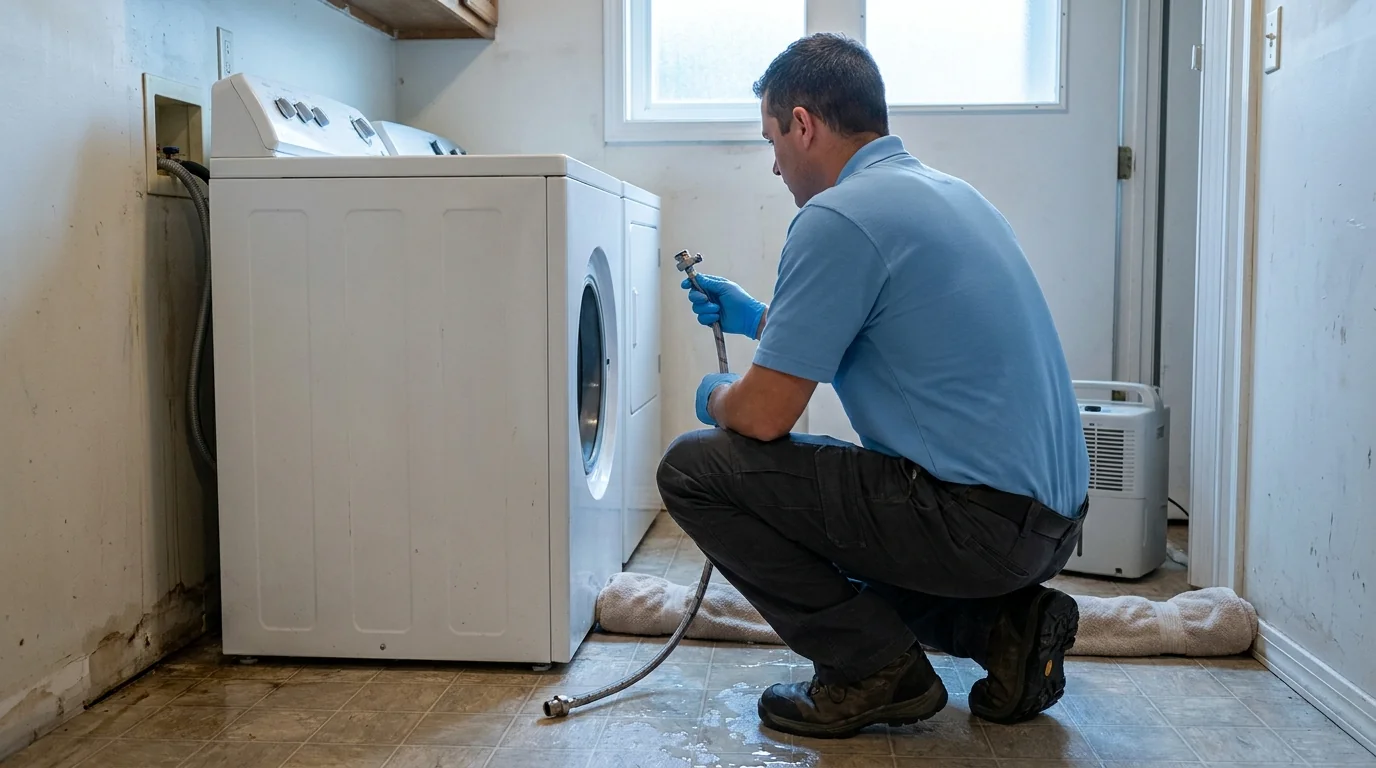
Appliance Leak Cleanup in Jersey City
24/7 appliance leak cleanup in Jersey City, NJ. IICRC-certified, insurance billing accepted. Call (908) 970-8533.
Our IICRC-certified technicians are dispatched from our Fair Lawn, NJ headquarters and are typically on-site in Jersey City within 60 minutes of your call.
A refrigerator ice-maker line that drips overnight or a washing machine hose that lets go mid-cycle doesn’t just soak a floor — in Jersey City’s stacked multifamily buildings, that water moves fast and far. At Newport or along the Exchange Place waterfront, a single supply-line failure on the 12th floor can show up as ceiling stains on the 10th before anyone notices the source. In the Heights or Bergen-Lafayette, the same leak hits century-old subfloor and travels toward a basement that may already be damp from a combined-sewer system that backs up every hard rain. The Restoration Group responds 24/7, documents damage unit by unit, and dries structures to IICRC S500 standards — the kind of paperwork building managers and condo boards actually need.
Why Jersey City Properties See Appliance Leak Problems
Jersey City runs two very different building inventories side by side. The high-rise condos and rentals clustered around Newport and the Exchange Place waterfront use pressurized supply lines, ice-maker feeds, and dishwasher connections that can fail silently inside cabinetry. Because units are stacked directly above one another, a slow drip behind a refrigerator can saturate the subfloor, wick into concrete decking, and appear as a blister in the drywall of the unit below — sometimes days later. Building management then needs unit-by-unit moisture readings and a written scope of work before the association’s insurer will open a claim.
In the Heights, Bergen-Lafayette, and Greenville, the housing stock tells a different story: brownstones and frame rowhouses built between the 1890s and 1920s, many with original wood subfloor, plaster walls, and cellars that sit close to the water table. A washing machine overflow or water heater failure in one of these homes doesn’t just wet a floor — it saturates old-growth lumber that holds moisture far longer than modern OSB, and it can reach a basement that Ida or Sandy already proved is vulnerable to flooding. The combination of aged materials and chronic groundwater pressure means appliance leaks here tend to cause more hidden damage than the visible footprint suggests.
Our Appliance Leak Cleanup Process in Jersey City
When you call (908) 970-8533, the first thing we do is identify the appliance source and confirm it’s isolated — shut-off valve closed, power disconnected if needed. From there, the process follows a consistent sequence calibrated to what we actually find in Jersey City properties:
Moisture mapping first. We use thermal imaging and calibrated moisture meters to trace where water traveled beyond the obvious wet area. In high-rise units, that means checking the ceiling of the unit below and the wall cavities adjacent to the appliance alcove. In older rowhouses in the Heights or Greenville, we probe subfloor and wall bases because plaster absorbs water slowly and releases it even more slowly — the wet zone is almost always larger than it looks.
Controlled extraction and material decisions. Standing water comes out with truck-mounted extraction. Saturated flooring materials — hardwood, tile backer, vinyl plank — are evaluated individually. We document what stays and what goes before anything is removed, which matters for insurance photo documentation.
Drying with calibrated equipment. Commercial desiccant dehumidifiers and air movers are placed based on psychrometric readings, not guesswork. We set monitoring logs and revisit daily until structural readings hit target. In high-density buildings, we coordinate equipment placement and access with building management so hallways and common areas aren’t blocked.
Final documentation. Every job closes with a moisture log, before-and-after photos, and a written scope — the format that both private insurers and condo association carriers expect.
Reaching Jersey City from Kenilworth
The Restoration Group is based in Kenilworth, NJ, and reaches Jersey City via the NJ Turnpike and Routes 1 and 9 into Hudson County. Because we operate 24/7, we can dispatch at any hour — whether the call comes from a building super at Newport at 2 a.m. or a homeowner in Bergen-Lafayette on a Sunday morning. ZIP codes 07302, 07304, and 07306 are areas we cover regularly, and we’re familiar with the parking and access logistics that come with both high-rise loading docks and narrow rowhouse blocks.
Jersey City Insurance and HOA Coordination
Appliance leak claims in Jersey City’s condo buildings almost always involve at least two parties: the unit owner’s HO-6 policy and the building’s master policy. We photograph and document each affected unit separately, note the moisture readings at the time of arrival, and produce a scope that clearly identifies what falls within the unit versus what’s common structure. That separation matters when adjusters are deciding which policy responds to which line item. For landlords managing multifamily properties in Journal Square or Greenville, we can provide the same documentation in a format that satisfies NJ Division of Consumer Affairs recordkeeping expectations.
Local Note
In the Heights and Bergen-Lafayette, many rowhouses have original horsehair plaster walls that predate modern drywall by 50 to 80 years. When an appliance leak saturates these walls, the plaster itself acts like a slow sponge — it absorbs water gradually and releases it at roughly half the rate of gypsum drywall. That means a wall that reads “dry” on a surface pin meter may still be holding significant moisture in the lath layer behind it. We use deep-wall probes and thermal imaging on these structures before closing out any drying phase, because calling a job complete too early in a plaster-wall home is one of the more reliable ways to grow mold inside a wall cavity that looks fine from the outside.
If an appliance leak has left standing water, wet flooring, or unexplained ceiling stains anywhere in Jersey City, call (908) 970-8533. We’ll map the damage, dry the structure, and produce the documentation your insurer or building management needs to move the claim forward.
Appliance Leak Cleanup in Jersey City: Service Coverage
Frequently Asked Questions
How fast can you arrive for appliance leak cleanup in Jersey City?
How quickly can The Restoration Group reach a high-rise condo at Newport or Exchange Place after an appliance leak call?
My washing machine flooded a unit in a Bergen-Lafayette rowhouse and the water reached the basement. Does the age of the building change how you approach cleanup?
My condo building's HOA in Downtown Jersey City is asking for unit-by-unit moisture documentation before they'll open an insurance claim. Can you provide that?
What appliances cause the most hidden damage in Jersey City apartments and condos?
Does Jersey City's combined-sewer system affect appliance leak cleanup in neighborhoods like Greenville or the Heights?
Appliance Leak Cleanup response in Jersey City
Most Jersey City calls see a technician on-site within 60 minutes from our Fair Lawn headquarters.