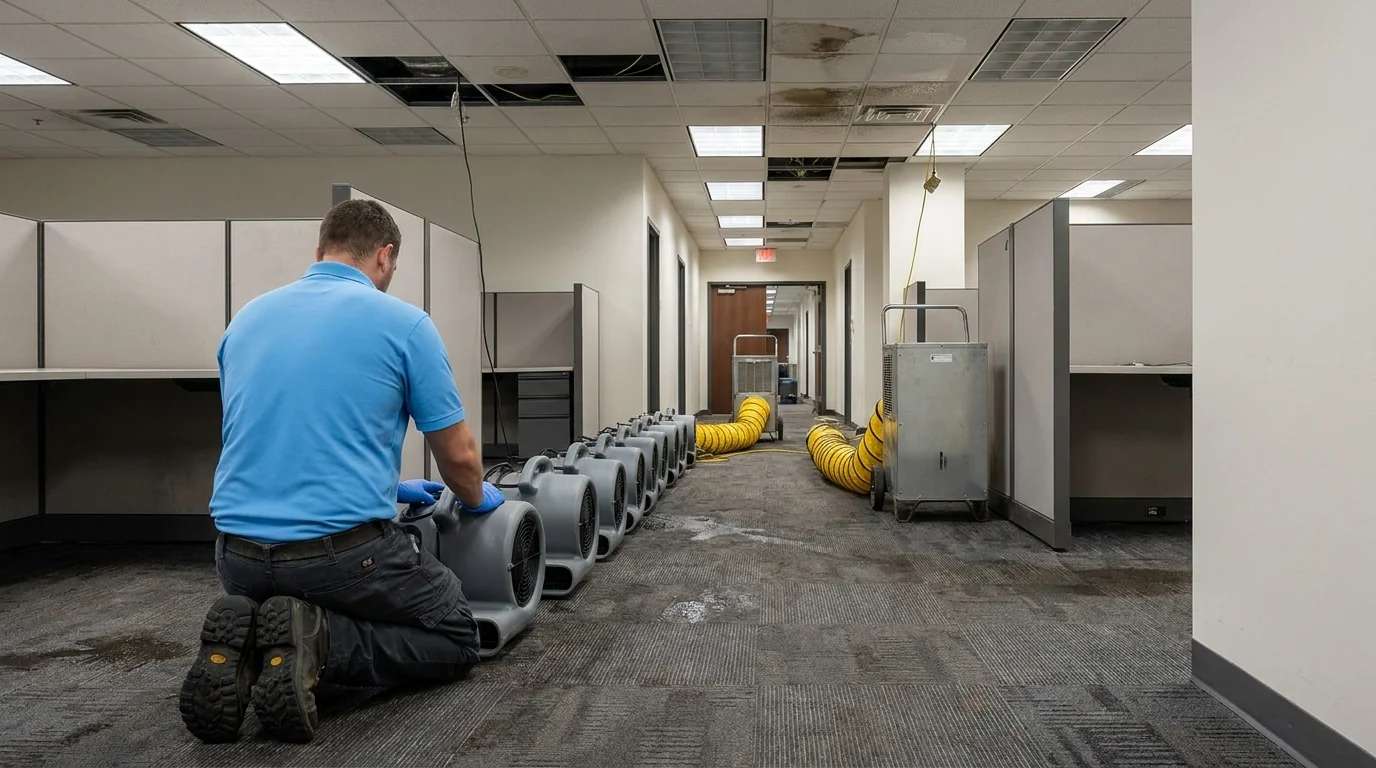
Commercial Restoration in Manhattan
24/7 commercial restoration in Manhattan, NY. IICRC-certified, insurance billing accepted. Call (908) 970-8533.
Our IICRC-certified technicians are dispatched from our Fair Lawn, NJ headquarters and are typically on-site in Manhattan within 60 minutes of your call.
When a supply line fails on the 22nd floor of a Midtown office tower, the damage doesn’t stop at the ceiling tiles — it migrates down through electrical conduits, elevator shafts, and the server room two floors below before anyone pulls the shutoff. Commercial losses in Manhattan move fast and compound in ways that rarely happen in single-story suburban buildings. Every hour a law firm, restaurant, or retail space sits closed is revenue that doesn’t come back, which is why The Restoration Group operates around the clock and mobilizes crews to Manhattan addresses day or night.
Why Manhattan Properties Face Distinct Commercial Restoration Challenges
Manhattan’s building stock spans more than a century of construction — pre-war office buildings with cast-iron risers, mid-century towers with aging mechanical rooms, and glass-curtain-wall high-rises all sharing city blocks. In the Financial District and Lower East Side, Hurricane Sandy’s storm surge left a documented record of what happens when saltwater infiltrates below-grade electrical switchgear and concrete foundations: corrosion and microbial growth that persisted for years after the visible water was gone. More recently, the remnants of Hurricane Ida overwhelmed storm drains from Harlem to Chelsea, backing sewage into ground-floor retail and restaurant spaces that had no flood history at all.
Vertical water migration is the defining characteristic of Manhattan commercial losses. A failed radiator valve or washing-machine connection on an upper floor doesn’t just saturate one tenant’s space — it tracks down through the building’s core, soaking drop ceilings, saturating insulation inside partition walls, and pooling inside elevator pits. Identifying every affected floor requires systematic moisture mapping, not a visual walk-through.
Our Commercial Restoration Process in Manhattan
When we arrive at a commercial property — whether it’s a co-op ground-floor retail space in the Upper East Side or a multi-tenant office building near Grand Central Terminal — the first priority is stopping secondary damage while the building keeps functioning. That means coordinating with the resident manager or property management company before we move a single piece of equipment.
Our process follows a structured sequence:
- Rapid assessment and source control — We locate and confirm the water or fire source is contained, then document affected areas with thermal imaging and calibrated moisture meters across every floor that may have been impacted.
- Unit-by-unit moisture logging — Manhattan managing agents and co-op boards require written records. We produce floor-by-floor moisture logs that satisfy both the building’s internal documentation requirements and insurance carrier standards.
- Extraction and structural drying — Industrial extractors, desiccant dehumidifiers, and directed airflow equipment are staged using freight elevators on a schedule coordinated with building management — typically overnight or during off-peak hours to avoid disrupting tenants.
- Scope documentation for insurance — We photograph affected materials, catalog damaged contents, and produce a written scope that aligns with adjuster expectations, reducing back-and-forth that delays claim resolution.
- Reconstruction coordination — Once drying goals are met and verified, we transition directly into rebuild, so tenants aren’t waiting on a second contractor mobilization.
As an IICRC Certified Firm (#210213), our drying protocols follow the S500 standard for water damage and the S700 standard for fire and smoke — the same benchmarks commercial insurance carriers use to evaluate whether mitigation was performed correctly.
Reaching Manhattan from Kenilworth
Our crews stage out of Kenilworth, NJ, with access to Manhattan via the Lincoln Tunnel and Holland Tunnel depending on the destination borough. For properties in the Financial District (ZIP 10038) or Lower Manhattan, the Holland Tunnel route typically gets us to the site faster. Midtown addresses near the Empire State Building or Times Square corridor are generally accessible via Lincoln Tunnel. Because we operate 24/7, we can dispatch during off-peak overnight hours when tunnel and surface traffic is lightest — which also aligns with the after-hours freight elevator windows most Manhattan commercial buildings require for equipment staging.
Manhattan Insurance and Property Management Coordination
Commercial losses in Manhattan almost always involve multiple stakeholders: the building owner, the tenant, the managing agent, the co-op or condo board, and one or more insurance carriers. We’re accustomed to that structure. We provide certificates of insurance before setting foot in the building, produce the unit-by-unit documentation that boards require, and communicate directly with adjusters to keep the claim moving. For retail and restaurant tenants in high-traffic corridors, we flag business interruption exposure in our documentation so the carrier has what it needs to evaluate that portion of the claim.
Local Note
One thing that catches out-of-market contractors in Manhattan: freight elevator access is not optional, and it is not always available on demand. Most commercial and residential towers in Midtown and the Upper West Side have scheduled freight windows — often 8 a.m. to 5 p.m. on weekdays, with after-hours access requiring advance coordination with the superintendent or management office. Showing up with a truck full of air movers and no freight reservation means equipment sits in the lobby. We confirm elevator scheduling before dispatch so drying equipment reaches the affected floors the same night we arrive, not the following afternoon.
If your Manhattan property has sustained water, fire, or smoke damage and every day closed is money your business isn’t making, call The Restoration Group at (908) 970-8533. We’ll coordinate with your building management, document the loss for your carrier, and get your space back to operational — without adding friction to an already complicated situation.
Commercial Restoration in Manhattan: Service Coverage
Frequently Asked Questions
How fast can you arrive for commercial restoration in Manhattan?
How do you handle after-hours access in Manhattan high-rises where freight elevators aren't available on demand?
A pipe failure on an upper floor affected multiple tenants in our Financial District building. How do you document a loss that spans several units?
Our Chelsea restaurant flooded after a storm overwhelmed the street drains. Does sewage backup change the restoration process?
How does vertical water migration in Manhattan office towers affect the drying timeline compared to a single-floor commercial loss?
Do you coordinate directly with managing agents and co-op boards for Upper East Side commercial and mixed-use properties?
Will my homeowners insurance cover commercial restoration in Manhattan?
Commercial Restoration response in Manhattan
Most Manhattan calls see a technician on-site within 60 minutes from our Fair Lawn headquarters.