Flood Damage Restoration in Manhattan
24/7 flood damage restoration in Manhattan, NY. IICRC-certified, insurance billing accepted. Call (908) 970-8533.
Our IICRC-certified technicians are dispatched from our Fair Lawn, NJ headquarters and are typically on-site in Manhattan within 60 minutes of your call.
When a riser pipe fails on the 14th floor of a pre-war co-op on the Upper East Side, the water doesn’t stop at one unit — it travels down through plaster ceilings, behind original horsehair-and-lath walls, and into the apartments of a dozen neighbors before anyone smells the damage. Manhattan flood losses are vertical by nature, and responding to them requires a different playbook than a suburban basement flood. The Restoration Group dispatches certified crews 24/7 to addresses across Manhattan, working within the building-management protocols that resident managers and co-op boards depend on.
Why Manhattan Properties Experience Flood Damage Differently
The borough’s housing stock spans more than a century of construction — pre-war buildings with cast-iron risers and gravity-fed radiator systems sit a few blocks from glass-curtain condo towers with modern plumbing chases. Both fail, just in different ways. Aging riser valves and washing-machine supply lines are among the most common culprits in the ZIP codes running from 10001 through 10038, but the city’s own infrastructure plays a role too. During Hurricane Ida, overwhelmed storm drains pushed water back up through basement-level floor drains from Harlem down to Chelsea. Hurricane Sandy’s surge inundated the Financial District and Lower East Side with saltwater — a corrosive load that standard freshwater drying protocols don’t fully address.
Below street level, Manhattan’s water table is high and its soil is largely schist and fill, which means groundwater intrusion after heavy rain can appear in sub-grade mechanical rooms and parking levels even in buildings that have never had a plumbing failure. Commercial tenants — restaurants, retailers, and offices — face an added pressure: every day a space is closed for mitigation is a day of lost revenue.
Our Flood Damage Restoration Process in Manhattan
The first step on any Manhattan job is moisture mapping. Technicians use thermal imaging cameras and calibrated moisture meters to trace how far water has migrated through floors, walls, and ceilings — critical in multi-unit buildings where the source unit and the affected units may be separated by several floors. We document findings room by room and unit by unit, producing the moisture logs that managing agents and boards typically require before authorizing further work.
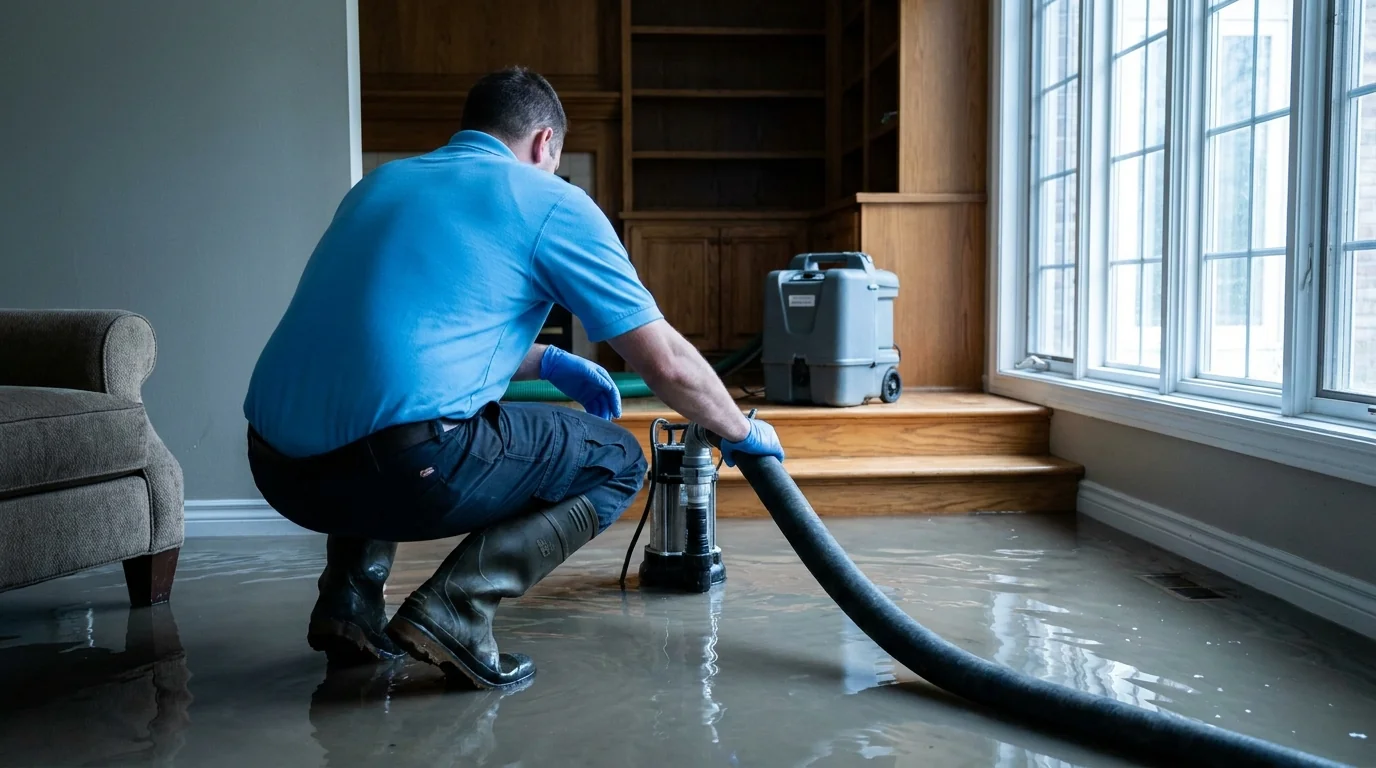
Extraction comes next. In occupied high-rises, that means coordinating freight-elevator windows with building staff — often early morning or late evening slots — so equipment moves don’t disrupt residents. Industrial-grade truck-mounted extractors pull standing water from hard surfaces; weighted extraction tools address water that has wicked into carpet padding and subfloor assemblies. Once bulk water is removed, drying chambers are established using commercial desiccant or refrigerant dehumidifiers and high-velocity air movers, calibrated to the specific materials present. Plaster, common in pre-war buildings across Midtown and the Upper West Side, releases moisture more slowly than modern drywall and requires extended drying cycles — typically 30 to 50 percent longer — before structural readings stabilize.
We dry to IICRC S500 standard, documenting psychrometric data at each check so there is a defensible record for insurance adjusters and building management alike.
Reaching Manhattan from Kenilworth
The Restoration Group’s base in Kenilworth, NJ puts crews within practical reach of Manhattan via the Lincoln Tunnel into Midtown or the Holland Tunnel into Lower Manhattan, with routing adjusted for time of day. Because our team is available around the clock, dispatch can begin immediately when a call comes in — whether the loss is in a Chelsea townhouse or a Financial District office tower. We carry certificates of insurance formatted to meet the requirements of New York City co-op and condo boards, so building management can authorize access without delay.
Manhattan Insurance and Building-Management Coordination
Flood claims in Manhattan often involve multiple parties: the unit owner’s HO-6 policy, the building’s master policy, and sometimes a commercial tenant’s business-interruption carrier. We photograph affected materials before any demolition, produce itemized scope-of-loss reports, and communicate directly with adjusters to support the claim process. For co-op and condo buildings, we provide the unit-by-unit moisture logs and drying records that boards and managing agents need to track liability across floors. Our team is accustomed to working within building rules — approved contractor lists, noise ordinances, and after-hours freight-elevator coordination — so the process moves without friction.
Local Note
One thing that surprises building managers unfamiliar with vertical flood losses: in Manhattan pre-war buildings, original plaster ceilings act almost like a reservoir. Water pools above the plaster skin, held in place by the lath, and can release suddenly — sometimes hours after the source leak has been stopped — when someone walks across the floor above or when temperature changes cause slight expansion. Experienced technicians probe above plaster surfaces before declaring an area dry, because a ceiling that looks intact can be holding gallons. Skipping that step leads to secondary collapses and mold growth inside the ceiling cavity weeks later.
If water is moving through your building — or you suspect it already has — call The Restoration Group at (908) 970-8533. We respond 24/7 across Manhattan, and we bring the documentation, equipment, and building-management experience that vertical flood losses in this borough demand.
Flood Damage Restoration in Manhattan: Service Coverage
Frequently Asked Questions
How fast can you arrive for flood damage restoration in Manhattan?
How quickly can The Restoration Group reach a flood emergency in Midtown or the Upper East Side?
A pipe failed on an upper floor of our co-op and water traveled down through three units — how do you handle multi-unit losses in Manhattan buildings?
Do Manhattan co-op and condo boards require special documentation before a restoration contractor can work in the building?
How does flood restoration work differently in Manhattan's pre-war buildings compared to newer construction?
The Lower East Side and Financial District flooded during both Sandy and Ida — are those areas at higher risk, and does that affect the restoration approach?
Will my homeowners insurance cover flood damage restoration in Manhattan?
Flood Damage Restoration response in Manhattan
Most Manhattan calls see a technician on-site within 60 minutes from our Fair Lawn headquarters.