Mold Inspection and Testing in Manhattan
24/7 mold inspection and testing in Manhattan, NY. IICRC-certified, insurance billing accepted. Call (908) 970-8533.
Our IICRC-certified technicians are dispatched from our Fair Lawn, NJ headquarters and are typically on-site in Manhattan within 60 minutes of your call.
Manhattan’s compressed, vertical density creates mold conditions that flat-spread suburban buildings rarely see. When a radiator valve fails on the 22nd floor of a pre-war Upper West Side co-op, the moisture doesn’t spread outward — it travels down through plaster, fireproofing, and concrete until three or four floors below are quietly colonizing behind wallpaper and inside mechanical chases. By the time a resident notices a musty smell or a dark stain near a baseboard, spore counts can already be elevated throughout the stack. A professional mold inspection and testing engagement — not a visual guess — is the only way to know what you’re actually dealing with.
Why Manhattan Buildings Are Unusually Prone to Hidden Mold
The housing stock itself is part of the problem. Pre-war co-ops and early postwar rental towers throughout the Upper East Side and Chelsea were built with materials that absorb and hold moisture in ways modern construction doesn’t: horsehair plaster, rubble-fill walls, and terra-cotta tile block don’t dry the way gypsum board does. HVAC systems in older buildings often run through shared risers with minimal vapor barriers, and condensation inside those ducts goes unnoticed for years. Newer glass-curtain-wall towers in Midtown and the Financial District face a different issue — tight envelopes that trap interior humidity, especially in units with poor exhaust ventilation or oversized AC units that short-cycle and leave surfaces cold and damp.
Climate compounds the risk. New York summers push outdoor humidity into the 70–80% range for weeks at a time, and that moisture infiltrates through any gap in the building envelope. The flooding events from Hurricane Sandy and, more recently, Ida demonstrated how quickly groundwater and storm surge can saturate below-grade spaces from the Financial District to Harlem — and how long residual moisture lingers in foundation walls that were never designed to drain.
Our Mold Inspection and Testing Process in Manhattan
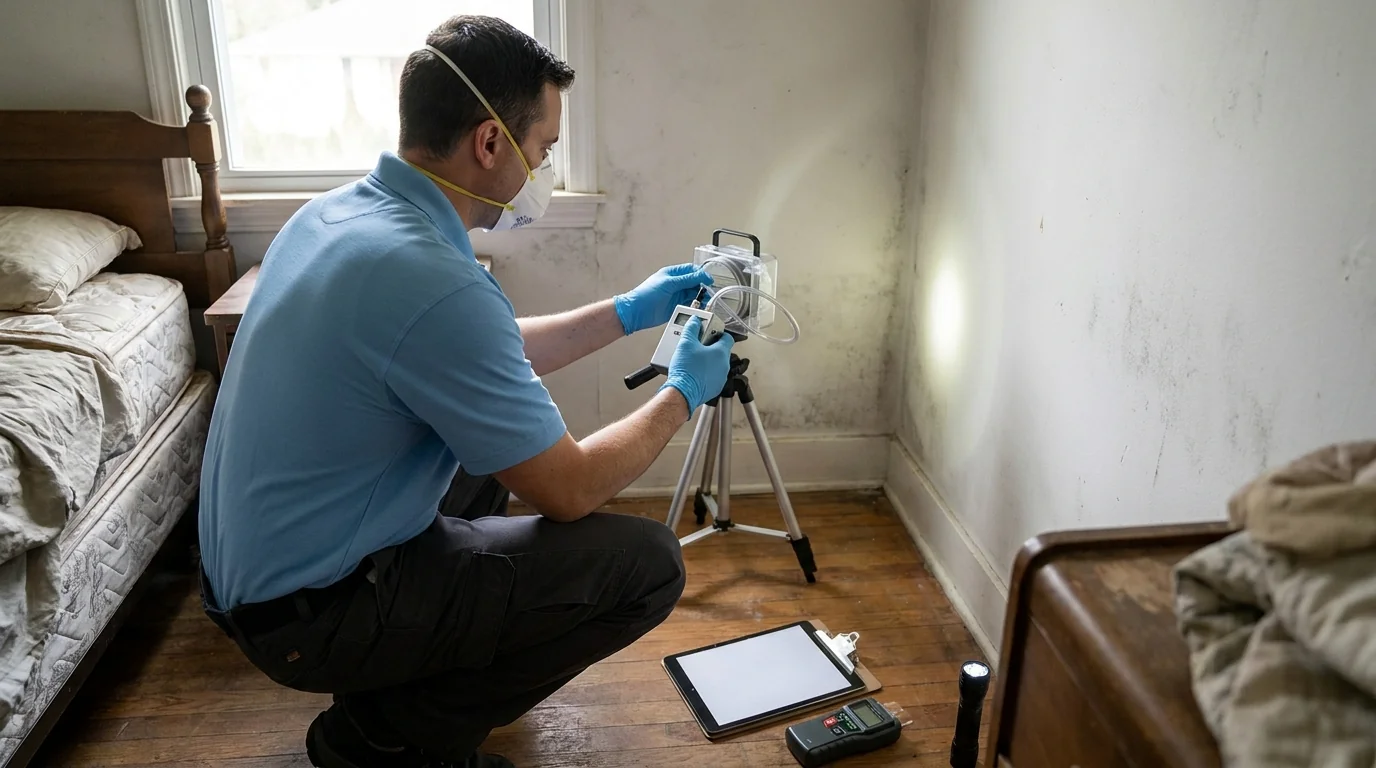
A mold assessment in a Manhattan building is not a single-unit exercise. We begin with a structured walkthrough that maps moisture readings across every suspect surface — walls, ceilings, subfloors, window frames — using calibrated thermal imaging and non-invasive moisture meters. Where readings are elevated or where visible staining exists, we collect air samples and, where appropriate, surface swab or tape-lift samples for laboratory analysis. All samples are sent to an accredited third-party laboratory; results typically return within 24–48 hours and include spore-type identification and concentration levels compared to outdoor baseline counts.
Because Manhattan losses are frequently multi-unit, we document findings room by room and floor by floor. Resident managers and managing agents receive a written moisture log and a clear chain-of-custody record for every sample collected — the kind of documentation co-op boards and condo associations expect before authorizing any remediation work. If your building requires certificates of insurance before we enter, we provide them in advance. We also coordinate freight-elevator access and after-hours scheduling when building rules require it, so the inspection doesn’t disrupt residents or violate house rules.
Reaching Manhattan from Kenilworth
The Restoration Group operates 24/7 and dispatches from Kenilworth, NJ, with direct access to Manhattan via the Lincoln Tunnel and the Holland Tunnel depending on the destination borough. For locations in the Financial District (ZIP 10038) or Lower Manhattan, the Holland Tunnel route typically gets our team on-site faster. For Midtown, the Upper East Side, or Harlem, the Lincoln Tunnel and the West Side Highway corridor are the more direct approach. We call ahead to confirm building access protocols — freight elevator reservations, lobby sign-in procedures, and any board-required notice periods — so time isn’t lost at the door.
Manhattan Insurance and Board Coordination
Mold claims in Manhattan co-ops and condos involve at least two layers of insurance: the unit owner’s HO-6 policy and the building’s master policy. Determining which policy covers which surfaces — and which party is responsible for the moisture source — often requires documentation that goes beyond a simple photograph. Our inspection reports are formatted to support insurance submissions: they include moisture readings with timestamps, laboratory chain-of-custody forms, annotated floor plan sketches, and a written narrative explaining the likely moisture pathway. We work with adjusters from most major carriers and can communicate directly with managing agents to keep the claim moving without putting the burden entirely on the unit owner.
Local Note
In pre-war Manhattan buildings with plaster-and-lath wall construction — common in co-ops throughout the Upper West Side and parts of Harlem — mold often grows on the back face of the lath, completely invisible from the room side. Thermal imaging can suggest elevated moisture behind the plaster, but a definitive answer sometimes requires a small exploratory opening. We flag this possibility before the inspection begins so building management and the unit owner can decide together whether invasive sampling is warranted, rather than discovering mid-inspection that the scope needs to expand.
If you’re dealing with a musty smell, a water stain that keeps coming back, or a recent leak that was “dried out” but never tested, a proper mold inspection is the right first step. Call The Restoration Group at (908) 970-8533 — our team understands how Manhattan buildings work and will deliver the documentation your board, your insurer, and your peace of mind actually require.
Mold Inspection and Testing in Manhattan: Service Coverage
Frequently Asked Questions
How fast can you arrive for mold inspection and testing in Manhattan?
Can you inspect a unit in a co-op or condo building on the Upper East Side without disrupting other residents?
How does mold testing work when a leak has traveled through multiple floors of a Manhattan high-rise?
Are pre-war buildings in Chelsea and the Upper West Side at higher risk for hidden mold than newer construction?
What does a mold inspection report include, and will it satisfy a Manhattan co-op board's documentation requirements?
How long does mold have to grow before it becomes a health concern in a Manhattan apartment?
Will my homeowners insurance cover mold inspection and testing in Manhattan?
Mold Inspection and Testing response in Manhattan
Most Manhattan calls see a technician on-site within 60 minutes from our Fair Lawn headquarters.