Odor Removal and Deodorization in Manhattan
24/7 odor removal and deodorization in Manhattan, NY. IICRC-certified, insurance billing accepted. Call (908) 970-8533.
Our IICRC-certified technicians are dispatched from our Fair Lawn, NJ headquarters and are typically on-site in Manhattan within 60 minutes of your call.
Manhattan’s density means odors don’t stay where they start. Smoke from a kitchen fire on the 22nd floor of a Chelsea high-rise seeps through HVAC returns and elevator shafts into neighboring units before the fire department has finished ventilating the building. Cooking grease baked into a closed restaurant overnight, a pet-soiled subfloor in a pre-war Upper East Side co-op, or flood-driven mildew left behind after a storm like Ida overwhelms the drain lines from Harlem to the Financial District — each scenario leaves a chemical signature in porous materials that no amount of ventilation alone will clear. The Restoration Group deploys IICRC-certified technicians 24/7 to address odor at its molecular source, not just its surface.
Why Manhattan Properties See Persistent Odor Problems
The borough’s building stock creates conditions that amplify and trap odors in ways that rarely occur in single-family suburban homes. Pre-war co-ops — the kind that line West End Avenue on the Upper West Side or the side streets off Fifth Avenue in the 10021 ZIP code — were built with plaster walls over wood lath, horsehair insulation, and original hardwood floors laid directly on subfloor. These materials are highly porous. Smoke and moisture-driven odors penetrate deeply and off-gas slowly for weeks after the visible damage is gone.
Modern condo towers present a different challenge: sealed, mechanically ventilated buildings recirculate air through shared systems. A single unit with a fire or sewage backup can push odor molecules into the common corridor, the mechanical room, and adjacent units within hours. Resident managers and building boards in these properties have seen it before — they expect unit-by-unit documentation and a clear scope of work before any equipment is brought through the freight elevator.
Manhattan’s climate adds pressure. Summer humidity regularly climbs above 70%, which reactivates odor compounds that seemed dormant after an initial cleaning. Winter brings the opposite problem: sealed windows and radiator heat create a concentrated indoor environment where even low-level odors become impossible to ignore.
Our Odor Removal and Deodorization Process in Manhattan
Effective odor elimination follows the contamination, not just the complaint. When a call comes in — whether it’s a smoke odor removal request from a Midtown restaurant that had a grease fire or a mildew complaint from a Lower East Side apartment after a riser failure — the process starts with a source inspection, not equipment deployment.
Source identification and containment. Technicians trace the odor to its origin material: char residue, saturated subfloor, contaminated HVAC components, or decomposing organic matter. Affected materials that cannot be cleaned are documented for removal before deodorization begins — treating over a contaminated substrate is the most common reason odors return.
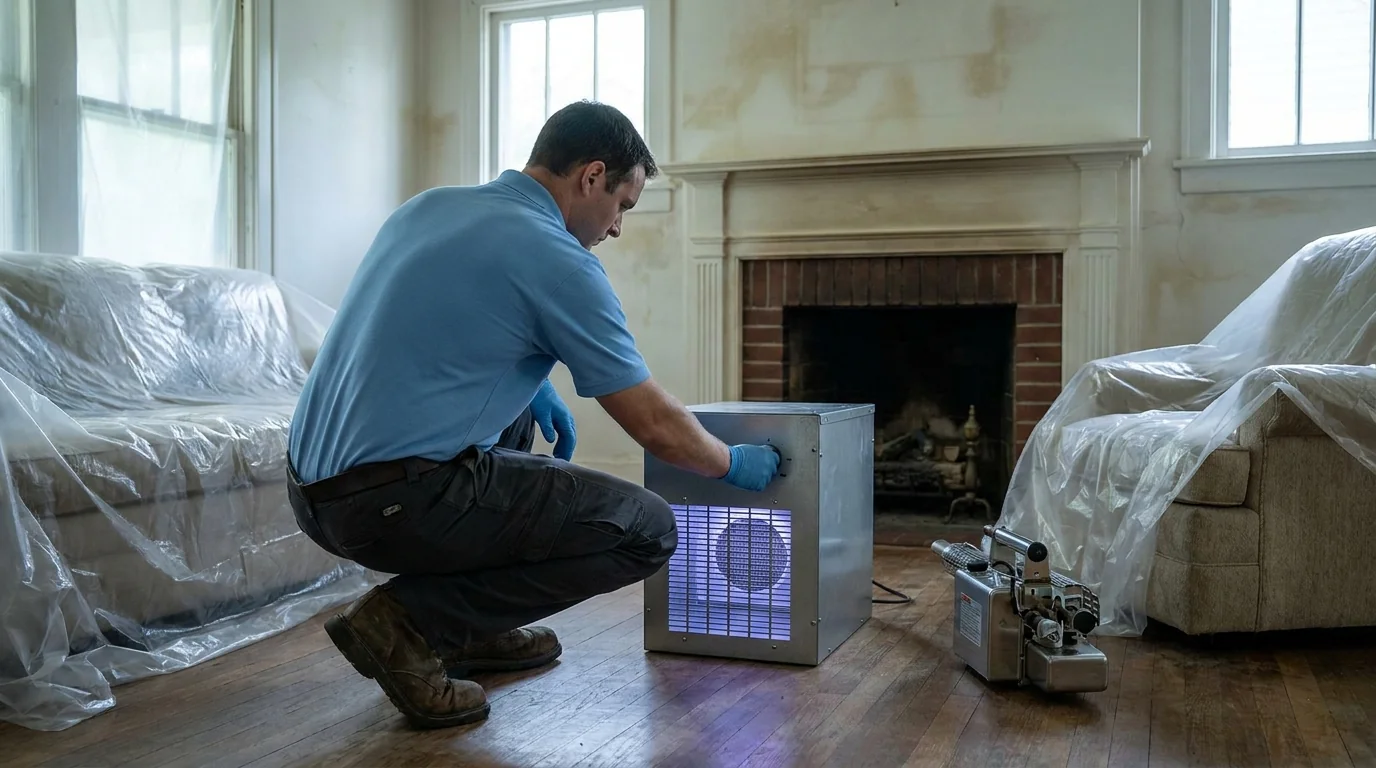
Method selection calibrated to the space. Manhattan jobs rarely allow a one-size approach. Thermal fogging — which generates a fine deodorizing vapor that penetrates the same pathways smoke traveled — works well in open residential and commercial spaces. Hydroxyl deodorization is the preferred method when occupants or neighboring units cannot be fully vacated, because hydroxyl generators are safe to run in occupied spaces and produce no ozone. Ozone treatment delivers faster results in unoccupied spaces and is effective for heavy smoke odor removal in sealed environments, but requires strict re-entry protocols. The right method depends on the building type, occupancy status, and the specific odor compound involved.
Verification before close-out. Odor levels are assessed before equipment is removed. In buildings where the managing agent requires documentation — common in co-ops and larger condo associations — a written deodorization report is provided alongside the moisture log.
Equipment and Methods We Use for Odor Removal
The Restoration Group carries the full range of professional odor elimination technology:
- Hydroxyl generators for occupied or semi-occupied spaces — safe for people, pets, and electronics, effective against smoke, mold, and biological odors
- Ozone treatment systems for unoccupied environments where rapid, deep penetration is needed
- Thermal fogging equipment to replicate the dispersal pattern of smoke or water vapor, reaching voids and cavities that surface treatments miss
- HEPA air scrubbers to capture particulate matter carrying odor compounds during and after treatment
- Moisture meters and thermal imaging to confirm that wet materials driving microbial odor are fully dried before the job is closed
For commercial properties — restaurants near Times Square, office suites around Grand Central Terminal, retail spaces in Chelsea — equipment staging and overnight scheduling are coordinated to minimize business interruption.
Local Note: What Manhattan Building Rules Mean for Odor Work
Anyone who has worked regularly in Manhattan co-ops knows that the building itself is a stakeholder in every restoration job. Boards and managing agents in buildings throughout the Upper East Side and Midtown routinely require a certificate of insurance naming the building as an additional insured before a vendor can bring equipment past the lobby. Freight elevator access is often restricted to specific hours — typically before 8 a.m. or after 6 p.m. — which means thermal fogging or ozone treatment scheduled for an unoccupied unit needs to be planned around the building’s logistics, not just the restoration timeline. The Restoration Group’s teams are accustomed to this workflow: we contact the resident manager in advance, confirm COI requirements, and schedule equipment moves during approved windows so the job doesn’t stall at the service entrance.
For odor removal work in Manhattan, call The Restoration Group at (908) 970-8533 — available around the clock. Whether the source is smoke, mold, sewage, or something harder to name, the team will identify it, treat it with the right method for your specific building, and document the result.
Odor Removal and Deodorization in Manhattan: Service Coverage
Frequently Asked Questions
How fast can you arrive for odor removal and deodorization in Manhattan?
Can you reach a Midtown or Upper East Side building quickly for an odor emergency?
Do Manhattan co-op boards or condo associations place restrictions on ozone treatment or thermal fogging?
A fire in a neighboring unit left smoke odor in my apartment in the 10021 ZIP code — am I responsible for the remediation cost?
What's the difference between hydroxyl deodorization and ozone treatment, and which is right for a Manhattan apartment?
How long does professional odor removal typically take in a Manhattan high-rise unit versus a ground-floor retail space?
Will my homeowners insurance cover odor removal and deodorization in Manhattan?
Odor Removal and Deodorization response in Manhattan
Most Manhattan calls see a technician on-site within 60 minutes from our Fair Lawn headquarters.