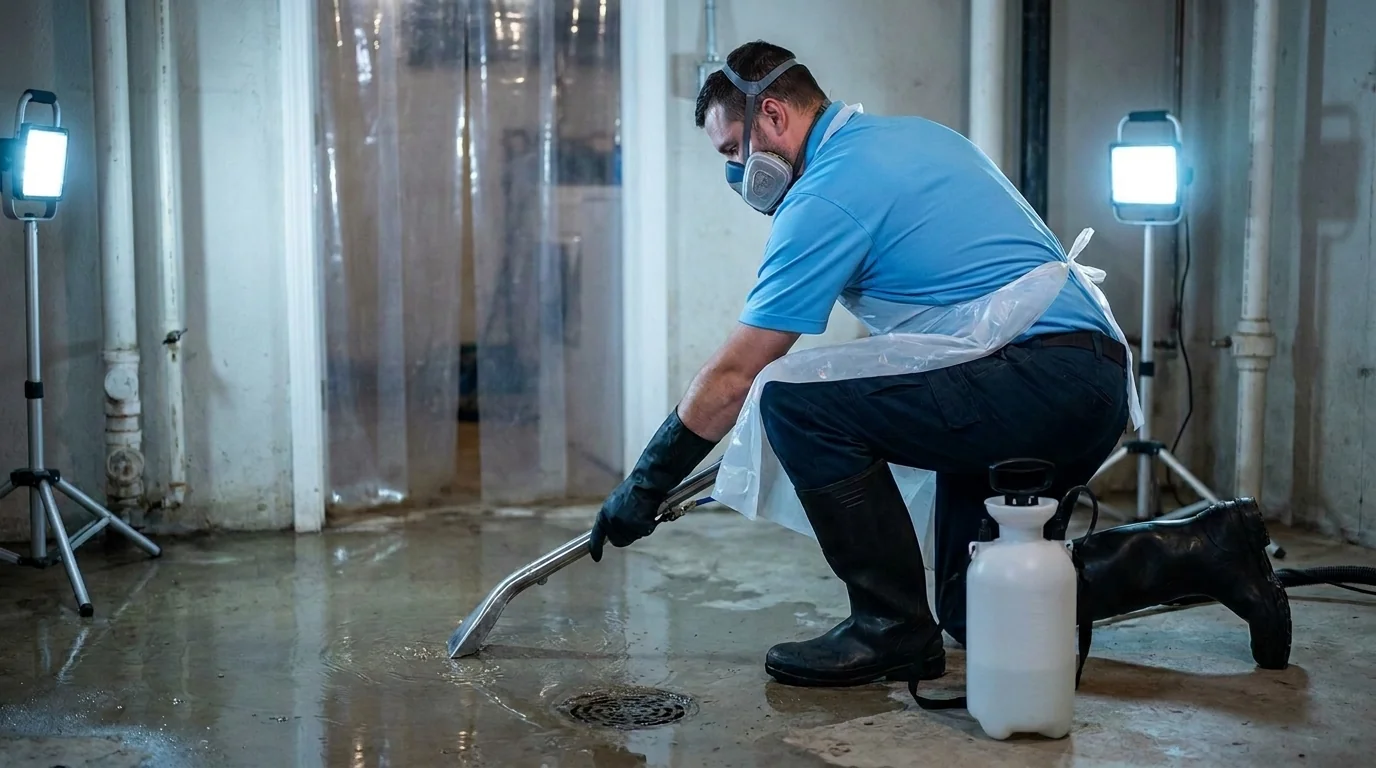
Sewage Cleanup and Sanitization in Manhattan
24/7 sewage cleanup and sanitization in Manhattan, NY. IICRC-certified, insurance billing accepted. Call (908) 970-8533.
Our IICRC-certified technicians are dispatched from our Fair Lawn, NJ headquarters and are typically on-site in Manhattan within 60 minutes of your call.
When a sewer line backs up in a Manhattan high-rise, the problem rarely stays contained to one unit. Raw sewage can travel through shared drain stacks, saturate subfloor assemblies, and seep into the unit directly below before a resident even realizes something is wrong. Whether the source is a failed riser in a pre-war co-op on the Upper East Side or a blocked municipal lateral beneath a Chelsea townhouse, the window for preventing secondary contamination — and the bacterial colonies that follow — is measured in hours, not days. The Restoration Group responds 24/7 and can reach most Manhattan addresses directly from our Kenilworth, NJ base.
Why Manhattan Properties Face Distinct Sewage Backup Risks
Manhattan’s sewer infrastructure dates back in many neighborhoods to the late 19th and early 20th centuries. Combined sewer overflows — where stormwater and sanitary waste share the same pipe — are common throughout the borough. During heavy rain events like the remnants of Hurricane Ida, which overwhelmed drains from Harlem down through Chelsea in 2021, those combined lines can surcharge and push raw sewage backward into building laterals and basement drains faster than any sump system can handle.
The borough’s vertical density compounds the problem. In pre-war co-op buildings, cast-iron drain stacks that run 15 or 20 stories are often original to the building. A partial blockage or joint failure on an upper floor means contaminated water follows gravity through every horizontal branch below it. Modern condo towers in Midtown and the Financial District have newer plumbing, but high occupancy loads and grease accumulation in commercial kitchen lines on lower floors create their own failure points. In either building type, a single sewage event can affect multiple units simultaneously — and multiple unit owners, boards, and managing agents simultaneously.
Our Sewage Cleanup and Sanitization Process in Manhattan
Sewage is classified as Category 3 water — the most contaminated classification under IICRC standards — because it contains bacteria, viruses, and pathogens that pose real health risks. Our process reflects that.
Containment first. We establish physical containment barriers to prevent cross-contamination to unaffected areas of the building before extraction begins. In a multi-unit residential building, that often means coordinating with the resident manager to restrict freight elevator access and protect common corridors.
Extraction and removal. Standing sewage is extracted using truck-mounted and portable units capable of handling solid-laden waste. Porous materials — drywall, carpet, insulation, wood subfloor — that have direct contact with Category 3 water are removed and bagged for disposal per New York City Department of Sanitation guidelines for regulated waste.
Disinfection and sanitization. After structural materials are removed, all affected surfaces are treated with EPA-registered antimicrobial agents. We document surface temperatures, dwell times, and product application rates — the kind of records that building boards and managing agents in ZIP codes like 10021 and 10016 routinely request before authorizing scope approvals.
Drying and verification. Commercial desiccant dehumidifiers and air movers are positioned to dry structural cavities. Moisture readings are logged by unit and by date, creating a paper trail that supports both insurance claims and co-op board closeout requirements.
Working Inside Manhattan’s Building Processes
This is where sewage cleanup in Manhattan diverges sharply from a suburban house call. Resident managers, co-op boards, and managing agents operate on formal approval chains. Before we touch a shared wall or a common-area ceiling, we provide certificates of insurance naming the building entity as additionally insured — a standard requirement that many out-of-market contractors overlook until it stalls the job.
After-hours freight elevator reservations, noise ordinance windows for equipment operation, and unit-by-unit moisture logs for board review are all part of how we scope Manhattan work from the first call. Retail and restaurant tenants in buildings along the Lower East Side or in Midtown face a different pressure: every day the space is closed is direct revenue loss. We plan commercial mitigation around overnight access windows wherever the building permits it.
Local Note
In pre-war buildings throughout the Upper West Side and Upper East Side, original terrazzo and encaustic tile floors are often set over a thick mortar bed — sometimes three to four inches deep. That mortar bed absorbs and holds Category 3 water long after the surface appears dry. Standard moisture meters read the tile surface, not the mortar beneath. We use penetrating probes and thermal imaging to confirm actual moisture levels in the assembly before closing out a sewage job, because a false clearance in a mortar-bed floor is exactly the condition that produces a mold call six weeks later.
If you’re dealing with sewage backup, raw sewage removal, or a sewer line backup anywhere in Manhattan — from a Financial District commercial space to a Harlem brownstone — call The Restoration Group at (908) 970-8533. We’re available around the clock, we understand how Manhattan buildings operate, and we carry the documentation your board or managing agent will ask for before work begins.
Sewage Cleanup and Sanitization in Manhattan: Service Coverage
Frequently Asked Questions
How fast can you arrive for sewage cleanup and sanitization in Manhattan?
How quickly can The Restoration Group reach a sewage backup in Manhattan from Kenilworth, NJ?
Does a sewage backup in a Manhattan co-op affect neighboring units, and how do you document that for the board?
Are pre-war buildings in the Upper West Side or Upper East Side harder to dry after a sewage backup?
What waste disposal rules apply to sewage-contaminated materials removed from a Manhattan property?
Can a combined sewer overflow during a heavy storm cause sewage backup in a building that has no plumbing problems?
Will my homeowners insurance cover sewage cleanup and sanitization in Manhattan?
Sewage Cleanup and Sanitization response in Manhattan
Most Manhattan calls see a technician on-site within 60 minutes from our Fair Lawn headquarters.