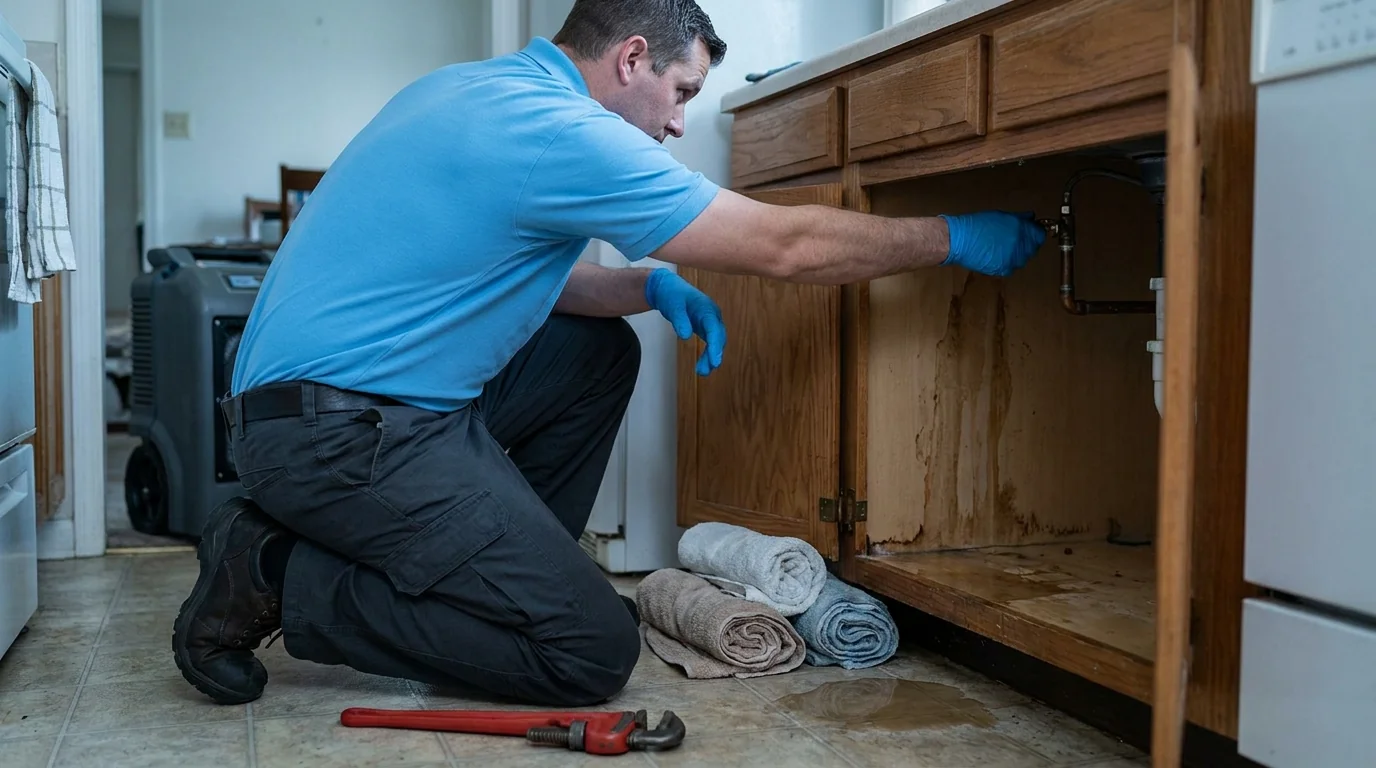
Burst Pipe Cleanup and Repair in Newark
24/7 burst pipe cleanup and repair in Newark, NJ. IICRC-certified, insurance billing accepted. Call (908) 970-8533.
Our IICRC-certified technicians are dispatched from our Fair Lawn, NJ headquarters and are typically on-site in Newark within 60 minutes of your call.
Newark winters hit hard, and when temperatures drop below freezing after a stretch of mild days — the kind of weather pattern that catches older buildings off guard — the pipes inside uninsulated exterior walls and unheated crawl spaces don’t stand a chance. A single riser failure in one of the Ironbound’s brick three-families can push hundreds of gallons through three stacked apartments before anyone reaches the shutoff. When that happens, the clock matters more than anything else, and The Restoration Group is reachable around the clock at (908) 970-8533.
Why Newark Properties See Burst Pipe Problems
Newark’s housing stock tells the story. The city is dense with pre-war construction — brick multifamily buildings, frame two- and three-families in neighborhoods like Vailsburg and Weequahic, and the grand colonials of Forest Hill — most of it built before modern pipe insulation standards existed. In those buildings, galvanized steel and older copper supply lines run through exterior chases and unheated basement utility rooms that see genuine freeze-thaw stress every January and February.
The problem compounds in multifamily settings. A burst supply line on the third floor doesn’t just damage one unit — water follows gravity through shared walls, soaks floor assemblies, and saturates the ceilings of the units below. By the time a tenant notices a wet ceiling, the structural cavity above has often been holding water for hours. Dense plaster-and-lath construction, common throughout Newark’s older stock, slows visible water migration, which means damage is frequently more extensive than it first appears.
Combined sewer infrastructure citywide adds another layer of risk. A pipe burst during a heavy rain event can coincide with sewer backpressure in the basement — turning a straightforward water loss into a mixed-water contamination situation that requires a different remediation protocol entirely.
Our Burst Pipe Cleanup and Repair Process in Newark
When we arrive, the first priority is stopping the water source if it hasn’t been shut off. We locate the affected supply line, assess whether the break is on the main, a branch line, or a fixture supply, and coordinate with the building owner or property manager on isolation. In multifamily buildings, that sometimes means working with the super to shut a riser valve that serves multiple units — we’re used to that coordination.
Once the water is controlled, we document everything before extraction begins. Photographs, moisture readings, and thermal imaging establish the scope of the loss — information your insurance carrier will need to process the claim. We then extract standing water using truck-mounted and portable extraction units, deploy drying equipment calibrated to the actual square footage and material types affected, and monitor daily until the structure reaches dry standard per the IICRC S500 protocol.
If the burst has affected structural materials — subfloor, wall cavities, ceiling assemblies — we perform controlled demolition to expose wet material that can’t be dried in place. In Newark’s older buildings, that often means removing plaster sections or original hardwood flooring that has cupped. We document removed materials for the insurance scope before disposal.
On the repair side, we handle pipe repair and replacement as part of the same job, so you’re not managing two separate contractors. Once the structure is dry and the repair is complete, we restore affected finishes to pre-loss condition.
Reaching Newark from Kenilworth
The Restoration Group’s shop in Kenilworth is roughly fifteen minutes from Newark via the Garden State Parkway or Route 22 to McCarter Highway — a route our crews run regularly. We serve the full city, from ZIP code 07105 in the Ironbound to the residential streets of Forest Hill and University Heights. Because we operate 24/7, a call at 2 a.m. gets the same response as a call at noon — a crew dispatched, not a voicemail.
For property managers overseeing multiple Newark addresses, we can coordinate simultaneous response to more than one location when a widespread freeze event affects several buildings at once.
Newark Insurance and Documentation
Most burst pipe losses in Newark are covered under standard homeowners or landlord policies as sudden and accidental water damage. We photograph the loss, generate moisture logs, and produce a written scope of work in the format most major carriers accept. We bill insurance directly and work with your adjuster through the claim — you shouldn’t have to translate between a remediation crew and an insurance desk.
For institutional clients near the arena district or the universities, we’re also set up to produce the documentation formats required for commercial property policies, which typically have stricter timeline and reporting requirements than residential claims.
Local Note
One thing that surprises property owners in the Ironbound and other low-lying Newark neighborhoods: when a burst pipe event happens during or just after a significant rain, the moisture readings inside wall cavities are often elevated before we even start drying — not just from the pipe break, but from ambient humidity driven by the area’s proximity to the Passaic River and the city’s combined sewer system. We account for that baseline when setting drying targets, because hitting standard dry numbers in a building that sits at higher ambient humidity requires more aggressive dehumidification and longer run times than the same job in a drier part of the state. Skipping that step means callbacks.
If you’re dealing with a burst pipe anywhere in Newark right now, call (908) 970-8533. The Restoration Group is an IICRC Certified Firm (#210213) and a licensed New Jersey Home Improvement Contractor — we carry the documentation your insurance company and your tenants will ask for, and we’re ready to move the moment you call.
Burst Pipe Cleanup and Repair in Newark: Service Coverage
Frequently Asked Questions
How fast can you arrive for burst pipe cleanup and repair in Newark?
How quickly can The Restoration Group reach the Ironbound or Downtown Newark after a pipe bursts?
Newark's older brick multifamily buildings have plaster walls — does that change how long drying takes after a pipe burst?
If a pipe burst in my Vailsburg two-family happened during heavy rain and the basement also has sewage backup, is that handled differently?
What does the pipe repair portion of the job involve, and do I need a separate plumber?
Will my Newark landlord insurance cover a burst pipe loss, and how does the claims process work?
Burst Pipe Cleanup and Repair response in Newark
Most Newark calls see a technician on-site within 60 minutes from our Fair Lawn headquarters.