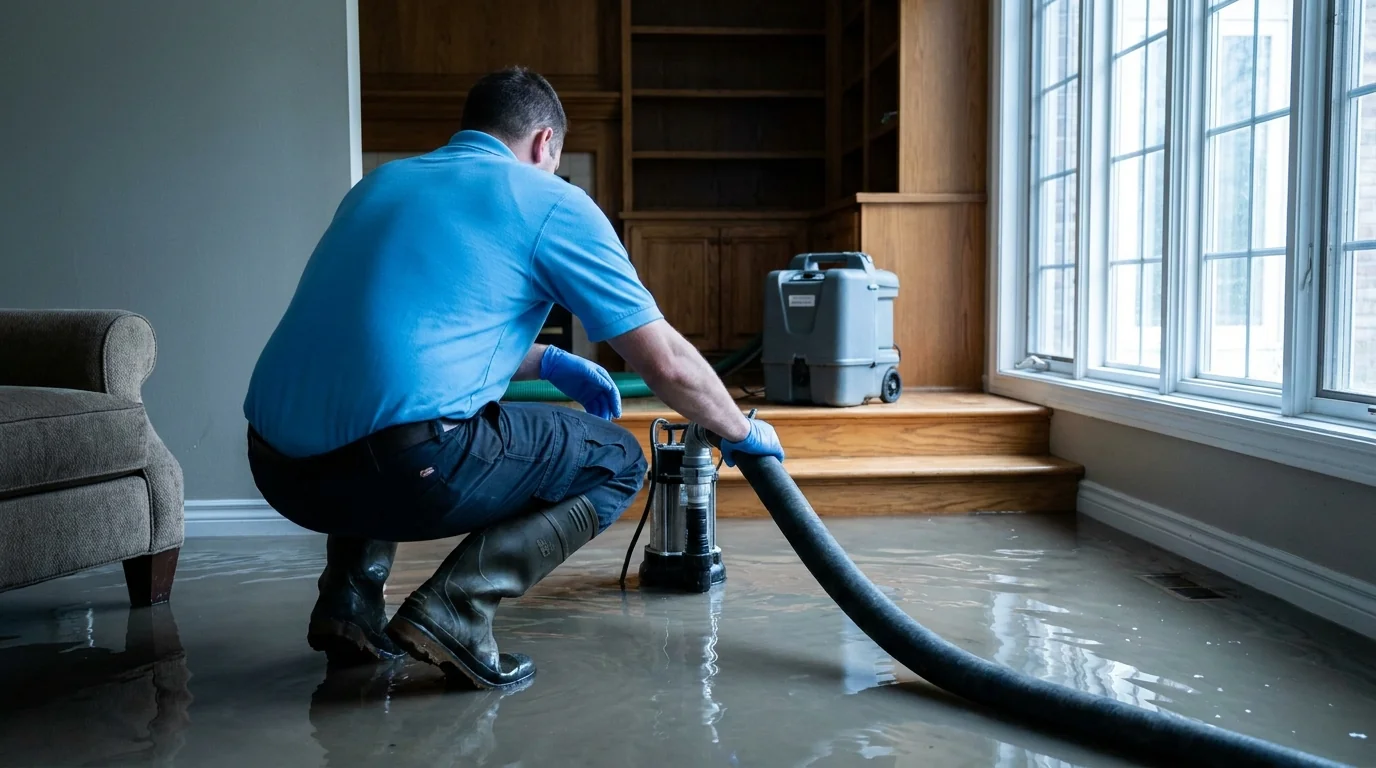
Flood Damage Restoration in Newark
24/7 flood damage restoration in Newark, NJ. IICRC-certified, insurance billing accepted. Call (908) 970-8533.
Our IICRC-certified technicians are dispatched from our Fair Lawn, NJ headquarters and are typically on-site in Newark within 60 minutes of your call.
When Ida stalled over New Jersey in September 2021, the Ironbound took some of the worst of it — streets along the Passaic turned into rivers, and basements that had stayed dry for decades filled in hours. That kind of flooding isn’t a fluke in Newark; it’s a recurring reality shaped by low-lying topography, aging combined sewer infrastructure, and a housing stock that was never designed with modern storm volumes in mind. When water gets in, it moves fast through dense brick multifamilies and pre-war frame two-families alike, and the window for preventing secondary damage is measured in hours, not days.
Why Newark Properties See Flood Damage Differently
Newark’s combined sewer system is the root cause of a problem that surprises a lot of property owners: in a heavy rain event, stormwater and sanitary sewage share the same pipes, and when those pipes surpass capacity, the overflow comes up through floor drains and basement toilets. That means a flood in a Weequahic two-family or a Forest Hill colonial isn’t just water — it’s a Category 3 contamination event requiring full sewage cleanup protocols, not a simple dry-out. The distinction matters because the extraction methods, the protective equipment, and the disposal requirements are all different.
The housing stock adds another layer. Forest Hill’s grand colonials and the dense brick multifamilies throughout University Heights and Vailsburg were built before modern vapor barriers and drainage membranes existed. Rubble-stone foundations are common, and they wick groundwater laterally through the block rather than channeling it to a sump. When a riser fails in a three-story multifamily, water follows the path of least resistance down through floor assemblies, soaking subfloor, framing, and finish materials on every level before anyone realizes the source. Landlords managing multiple units in ZIP codes like 07105 and 07108 know this pattern well.
Our Flood Damage Restoration Process in Newark
The first priority on arrival is establishing what category of water you’re dealing with. Sewer-influenced flooding — common in Newark basements after any significant storm — requires containment and antimicrobial treatment before extraction begins. Clean-water events from burst supply lines or appliance failures follow a different protocol, moving directly to high-volume extraction using truck-mounted units.
Once extraction is complete, we map moisture throughout the structure using thermal imaging and calibrated moisture meters. In pre-war construction, this step is especially important: plaster over wood lath holds water differently than modern drywall, and readings at the surface can understate how saturated the underlying framing actually is. Drying equipment — commercial desiccant dehumidifiers and high-velocity air movers — is positioned based on the moisture map, not by square footage alone. We monitor and document readings daily, which matters both for drying efficiency and for the insurance file.
For multifamily buildings, we coordinate access across units and communicate directly with property managers so tenants aren’t left without information during a disruptive process.
Reaching Newark from Kenilworth
The shop is in Kenilworth, roughly fifteen minutes up McCarter Highway from Newark’s core neighborhoods under normal conditions. Because the team operates around the clock, a call at 2 a.m. after a sewer backup in the Ironbound or a pipe failure near Newark Penn Station gets the same response as a midday call. We’re familiar with the access patterns across Newark’s neighborhoods — the narrow side streets in Vailsburg, the loading-dock logistics near the arena district — and we come prepared for them.
Newark Insurance and Documentation
Insurance carriers handling Newark flood claims want a documented chain of evidence: photos taken before any material is moved, moisture readings with timestamps, a written scope tied to line-item categories. We build that file from the moment we arrive. For landlords and property managers dealing with multiple-unit losses, we can produce unit-by-unit documentation so each affected tenant’s claim is clearly delineated. NJ Division of Consumer Affairs licensing means the paperwork we generate meets the standards carriers and adjusters expect in New Jersey.
Local Note
One thing that catches Newark property owners off guard: after a sewer-backup flood, the city’s Office of Emergency Management may require a record of the event and remediation scope before a certificate of occupancy is reissued for a rental unit. This is especially relevant for landlords in the Ironbound and along the lower Passaic corridor, where backup events are documented and tracked. We’re familiar with that documentation requirement and build the remediation report to satisfy it, which prevents delays when the property needs to be re-occupied.
If water is standing in your Newark property right now, call (908) 970-8533. The team will assess the contamination category, begin extraction, and start the insurance documentation immediately — because in an older Newark building, every hour of standing water is another hour of structural saturation that extends the drying timeline and the repair cost.
Flood Damage Restoration in Newark: Service Coverage
Frequently Asked Questions
How fast can you arrive for flood damage restoration in Newark?
How quickly can you reach the Ironbound or Weequahic after a flood call?
Newark basements flood from sewer backups, not just rainwater — does that change the cleanup process?
What's typical for flood drying timelines in Newark's older multifamily buildings?
Will my flood claim in Newark (ZIP 07105 or 07108) be handled differently than a standard homeowner claim?
Do Newark landlords need any city documentation after a sewer-backup flood before re-renting a unit?
Will my homeowners insurance cover flood damage restoration in Newark?
Flood Damage Restoration response in Newark
Most Newark calls see a technician on-site within 60 minutes from our Fair Lawn headquarters.