Mold Inspection and Testing in Newark
24/7 mold inspection and testing in Newark, NJ. IICRC-certified, insurance billing accepted. Call (908) 970-8533.
Our IICRC-certified technicians are dispatched from our Fair Lawn, NJ headquarters and are typically on-site in Newark within 60 minutes of your call.
When combined sewer backups flood Ironbound basements after a heavy rain — and in Newark, that happens more than most cities admit — the moisture doesn’t just drain away. It soaks into the concrete block, wicks up through the slab, and within 24 to 48 hours begins feeding mold colonies that are invisible to the naked eye but very much alive in the air your tenants breathe. A mold inspection and testing visit puts hard data behind what you’re smelling: air samples, surface swabs, and a written assessment that tells you exactly what species are present, at what concentrations, and whether remediation is warranted.
Why Newark Properties See Elevated Mold Risk
Newark’s housing stock is overwhelmingly pre-war — brick multifamily buildings, wood-frame two- and three-families, and the grand colonials of Forest Hill, many of them built before 1940. Older construction means original plaster walls, minimal vapor barriers, and basement waterproofing that was never designed for the kind of sustained moisture loading that comes from a changing climate. The Passaic River corridor, which runs along the eastern edge of the Ironbound, saw significant flooding during Hurricane Ida, and many properties in ZIP codes 07105 and 07106 are still dealing with residual moisture issues that were never properly assessed.
Beyond flooding, Newark’s dense urban fabric creates its own mold conditions. Attached rowhouses and multifamily buildings share wall cavities, so a slow leak in one unit can migrate moisture into neighboring units before anyone notices. Flat or low-slope roofs — common on the commercial-residential mixed buildings near Newark Penn Station and along the avenues in Vailsburg — pond water and develop membrane failures that feed attic mold for months before a stain appears on the ceiling below.
Our Mold Inspection and Testing Process in Newark
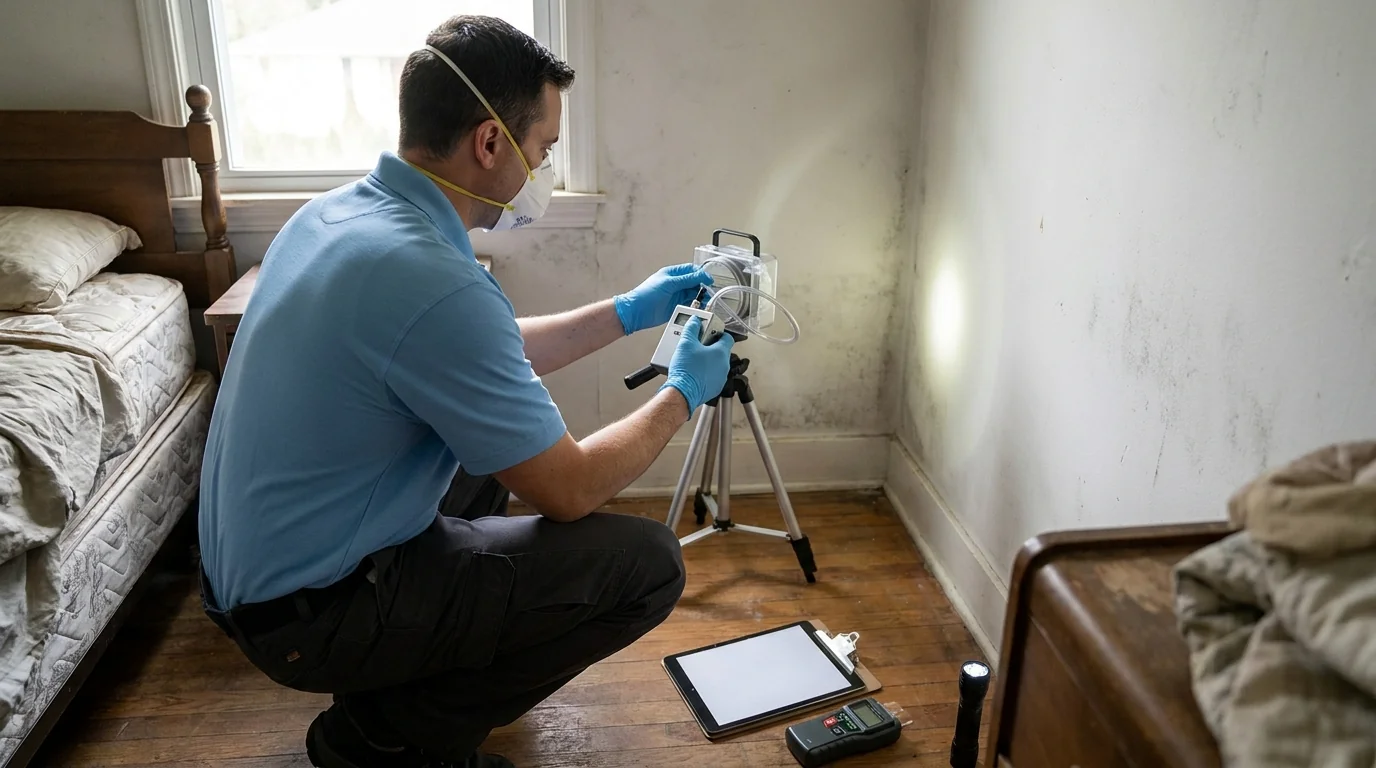
A proper mold assessment is not a visual walkthrough with a flashlight. The process starts with a thorough moisture mapping of the property using thermal imaging cameras and calibrated moisture meters, which locate hidden wet zones inside walls and under flooring without destructive opening. We then collect air samples from each affected zone alongside an outdoor control sample — the outdoor reading establishes the baseline spore count for that day in Newark, and the indoor readings are compared against it to determine whether amplification is occurring inside the building.
Surface samples (tape lifts or swabs) are collected from any visible growth and from suspect areas flagged by the moisture scan. All samples are sent to an accredited third-party laboratory, not analyzed in-house, which matters when you need documentation that will hold up with an insurance adjuster or a court. Results typically return within two to three business days. The written report identifies genus and species where possible, maps the affected areas, and includes a scope-of-work recommendation if remediation is needed — giving you a clear path forward rather than a vague suggestion to “address the moisture.”
The Restoration Group is an IICRC Certified Firm (#210213) and a licensed NJ Home Improvement Contractor, so the assessment report carries the credentials that insurance carriers and property managers in Newark expect.
Reaching Newark from Kenilworth
The shop is in Kenilworth, roughly fifteen minutes up McCarter Highway from Newark’s core. We serve the full city — from the dense residential blocks of Weequahic and University Heights to the commercial corridors near NJPAC and the arena district — with the same team and the same equipment. Because we operate around the clock, a call at 2 a.m. after a sewage backup in the Ironbound gets the same response as a call on a Tuesday afternoon. We schedule inspections to fit landlord and property manager timelines, including evenings when tenants need to be present.
Newark Insurance and Documentation Coordination
Landlords and property managers dealing with mold in Newark often face a two-track problem: the insurance carrier wants documented proof of causation (was this a sudden loss or long-term neglect?), and the tenant or local code enforcement wants proof that the problem is being addressed. Our inspection report is structured to satisfy both audiences. We photograph every sample location with GPS-tagged images, document moisture readings room by room, and produce a report formatted to accompany an insurance claim or a response to a housing code complaint.
New Jersey’s Department of Community Affairs has specific guidance on mold in rental housing, and Newark’s code enforcement has become increasingly active in responding to tenant complaints. Having a third-party certified assessment in hand — rather than a landlord’s verbal assurance — is the difference between a resolved complaint and a protracted dispute.
Local Note
One pattern we see repeatedly in Newark’s older multifamily buildings: the original horsehair plaster on interior walls holds moisture far longer than modern drywall, and it can show a “dry” reading on a standard pin-type moisture meter even when the substrate behind it is still wet. We use non-invasive radio-frequency meters alongside standard capacitance meters on plaster walls specifically because of this. In a Forest Hill colonial or an Ironbound rowhouse, skipping that step means missing the mold problem that’s already growing six inches behind a wall that reads clean on a basic scan.
If you’re dealing with a persistent musty odor, a tenant complaint, or the aftermath of a flood or sewage backup anywhere in Newark, a documented air quality and mold assessment is the first step toward a clear answer. Call The Restoration Group at (908) 970-8533 — we’ll schedule an inspection, collect the samples, and give you a written report you can actually use.
Mold Inspection and Testing in Newark: Service Coverage
Frequently Asked Questions
How fast can you arrive for mold inspection and testing in Newark?
Are Ironbound properties especially prone to mold after basement flooding?
How does Newark's pre-war housing stock affect the mold inspection process?
Can your mold assessment report be used to respond to a Newark code enforcement complaint?
What does air sampling actually measure, and how is it different from a visual inspection?
Do you handle mold inspections for large multifamily buildings and institutions near University Heights or the arena district?
Will my homeowners insurance cover mold inspection and testing in Newark?
Mold Inspection and Testing response in Newark
Most Newark calls see a technician on-site within 60 minutes from our Fair Lawn headquarters.