Odor Removal and Deodorization in Newark
24/7 odor removal and deodorization in Newark, NJ. IICRC-certified, insurance billing accepted. Call (908) 970-8533.
Our IICRC-certified technicians are dispatched from our Fair Lawn, NJ headquarters and are typically on-site in Newark within 60 minutes of your call.
Newark’s combined sewer system and dense pre-war housing stock create odor problems that linger long after the visible damage is gone. A basement backup in the Ironbound leaves behind hydrogen sulfide and microbial VOCs that soak into concrete block walls and floor joists. A kitchen fire in a Forest Hill colonial pushes smoke into plaster cavities that haven’t been opened since the 1930s. Standard air fresheners and even commercial foggers applied without a diagnostic plan just mask the source — and within days, the smell returns. The Restoration Group dispatches from Kenilworth around the clock to address the actual chemistry behind the odor, not just the symptom.
Why Newark Properties See Persistent Odor Problems
Newark is New Jersey’s largest city, and its housing reflects more than a century of dense urban construction. Brick multifamily buildings and frame two- and three-families — common from Vailsburg through Weequahic — share party walls and stacked floor systems that act as odor highways. One apartment fire doesn’t stay in one unit; smoke travels through electrical chases, plumbing penetrations, and shared attic spaces before anyone calls 911. The same is true for sewage: when combined sewers back up under heavy rain, the effluent doesn’t just pool on the floor — it wicks into subfloor assemblies, insulation batts, and the mortar joints of century-old brick foundations.
Newark’s proximity to Newark Liberty International Airport also matters in an indirect way: the city’s industrial and commercial corridors generate persistent background odors — diesel, solvents, food processing — that complicate baseline air-quality readings. Establishing a true pre-loss odor baseline is part of every scoping visit here, something that matters less in lower-density suburban markets.
Our Odor Removal and Deodorization Process in Newark
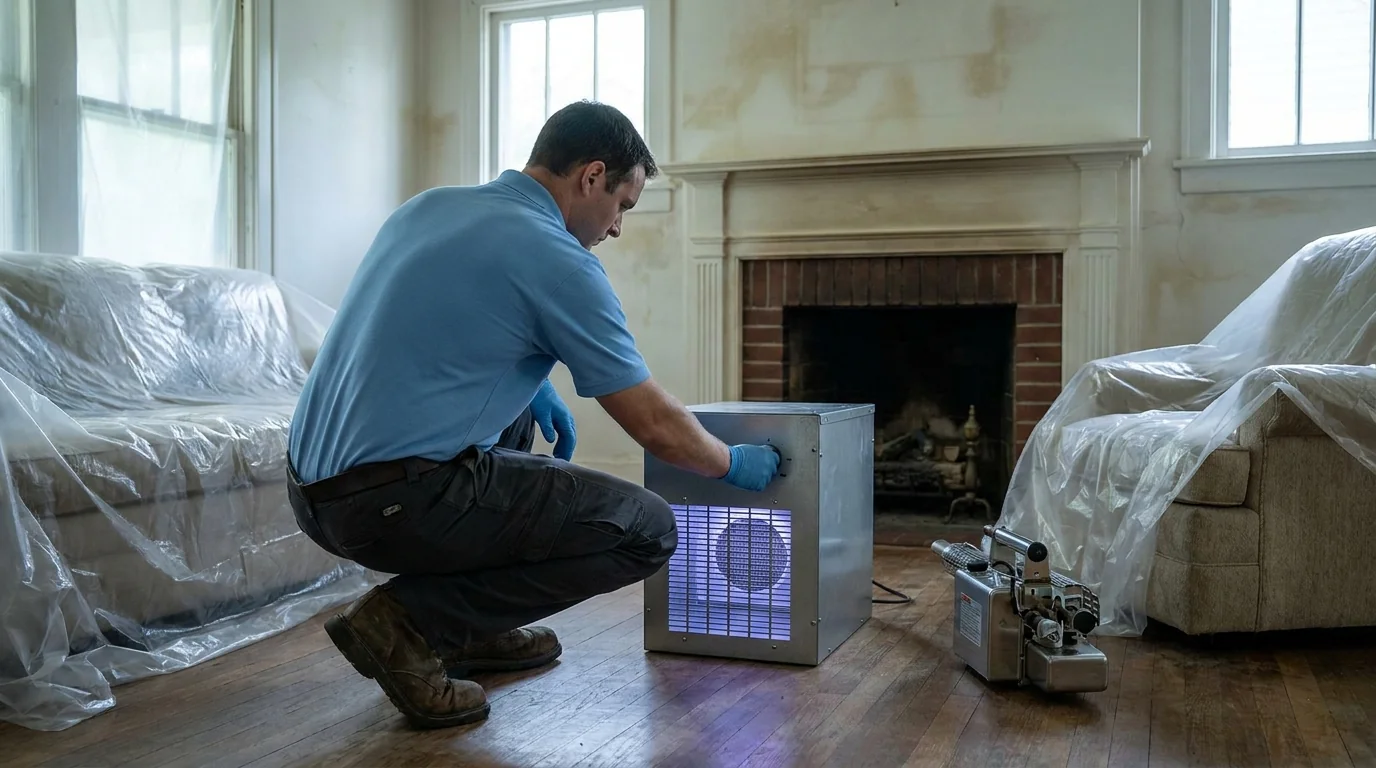
Every job starts with a source investigation, not equipment deployment. A technician identifies the odor category — smoke, sewage, protein (fire), mold, or chemical — because each requires a different chemistry to neutralize. Hydroxyl generators work well in occupied or semi-occupied spaces like the institutional buildings near University Heights, where ozone treatment would require full evacuation. Thermal fogging penetrates porous surfaces — plaster, brick, unfinished wood — by converting deodorizing solution into a fine aerosol that follows the same pathways smoke or sewage gases traveled. For heavy smoke odor in older homes, we often combine thermal fogging with ozone treatment in a sequenced protocol: fog first to coat interior surfaces, then run ozone in a sealed, unoccupied space to oxidize residual compounds.
After treatment, we verify results with calibrated photo-ionization detector (PID) readings rather than a subjective sniff test. Documentation matters here — property managers and insurance adjusters need a paper trail, not a technician’s assurance.
Reaching Newark from Kenilworth
The shop in Kenilworth sits roughly fifteen minutes up McCarter Highway from Downtown Newark under normal traffic conditions. Because the team operates 24/7, late-night calls from the Ironbound or ZIP codes like 07105 and 07102 reach a live dispatcher immediately — not a voicemail box. For multi-unit buildings near Prudential Center or Newark Penn Station, we coordinate building access with property managers before arrival so equipment staging doesn’t stall the job.
Newark Insurance and Documentation
Odor removal is frequently a covered loss when it follows a documented event — a fire, a sewage backup, a burst pipe. Landlords managing multifamily stock in Newark often deal with multiple carriers across a single building, and institutional clients near NJPAC or the hospital corridor have their own risk management contacts. The Restoration Group provides itemized moisture and air-quality readings, photo documentation of affected materials, and scope-of-work summaries formatted for direct submission to adjusters. As an IICRC Certified Firm (#210213) and NJ Licensed Home Improvement Contractor, the paperwork carries the credentials adjusters expect to see before approving a claim.
Local Note
In Newark’s older Ironbound and Vailsburg rowhouses, plaster-and-lath wall systems absorb smoke and sewage odor compounds differently than modern drywall. Plaster is denser and slower to off-gas, which means a thermal fogging treatment that would clear a 1990s frame house in a single session may need a second application and a longer dwell time in a pre-war building. We factor this into the initial scope rather than discovering it mid-job — it keeps timelines honest and prevents callbacks.
If you’re dealing with a smell that’s outlasted every cleaning attempt — in a rental unit, a historic home, or a commercial space anywhere in Newark — call (908) 970-8533. The Restoration Group will identify the source, apply the right treatment for the building type, and document the result so your insurer, your tenants, and your own nose are satisfied.
Odor Removal and Deodorization in Newark: Service Coverage
Frequently Asked Questions
How fast can you arrive for odor removal and deodorization in Newark?
How quickly can you reach the Ironbound or Downtown Newark for an odor emergency?
Newark's combined sewers back up into basements regularly — does sewage odor require different treatment than smoke odor?
Are pre-war multifamily buildings in neighborhoods like Vailsburg or Weequahic harder to deodorize than newer construction?
What's the difference between ozone treatment and hydroxyl deodorization, and which is used in occupied Newark buildings?
Will my insurance cover odor removal after a fire or sewage backup at my Newark rental property?
Odor Removal and Deodorization response in Newark
Most Newark calls see a technician on-site within 60 minutes from our Fair Lawn headquarters.