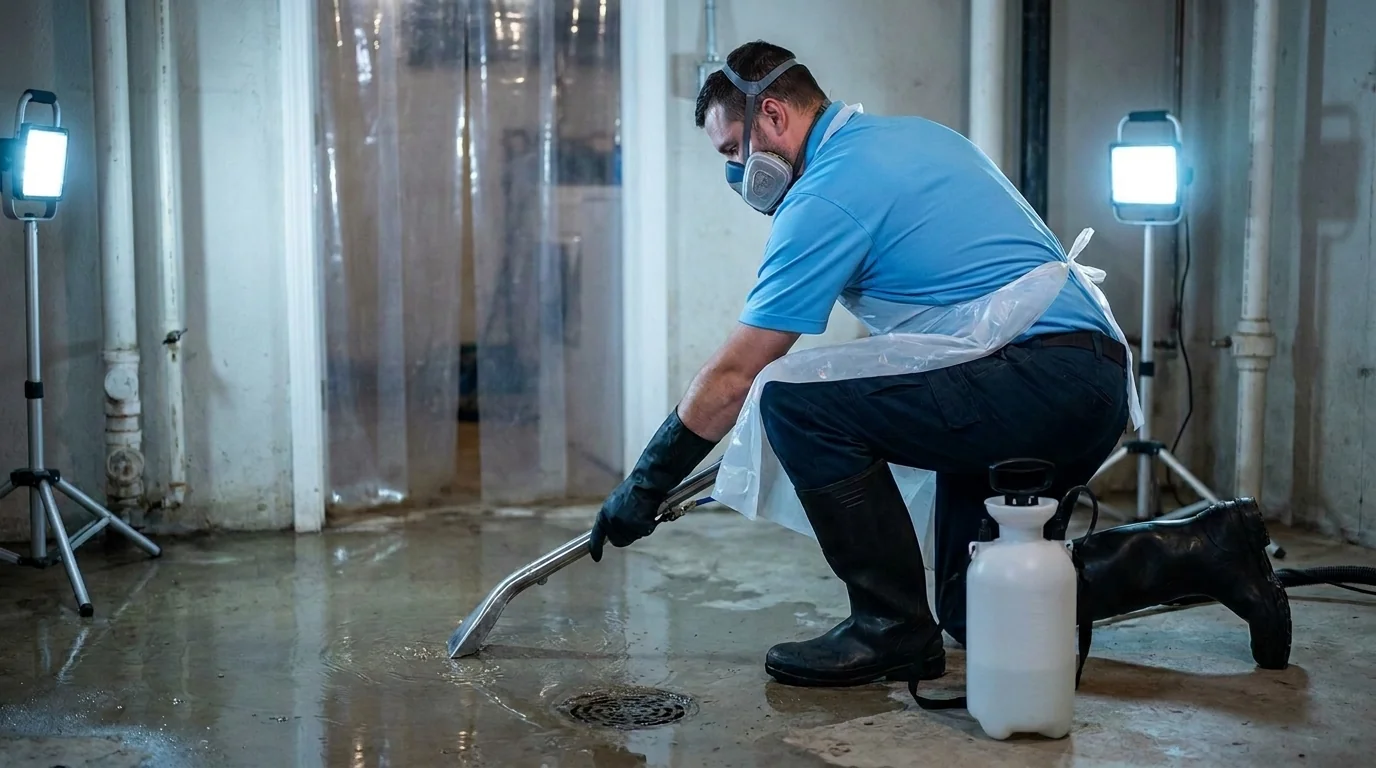
Sewage Cleanup and Sanitization in Newark
24/7 sewage cleanup and sanitization in Newark, NJ. IICRC-certified, insurance billing accepted. Call (908) 970-8533.
Our IICRC-certified technicians are dispatched from our Fair Lawn, NJ headquarters and are typically on-site in Newark within 60 minutes of your call.
Newark’s combined sewer system was never designed for the rainfall totals that storms like Ida drop in a matter of hours. When those sewers surcharge, raw sewage doesn’t just pool in the street — it pushes back through floor drains and toilet bases into the basements of the Ironbound’s brick row houses, the frame two-families in Vailsburg, and the ground-floor units of multifamily buildings across the city. That mix of fecal matter, grease, and street runoff is classified Category 3 water — the most hazardous contamination class in the IICRC S500 standard — and it requires a response that goes well beyond a wet vac and a mop.
Why Newark Properties See Sewage Backup Issues
Newark’s infrastructure tells the story. Much of the city’s sewer network dates to the early twentieth century, when combined systems — storm and sanitary in the same pipe — were standard practice. During heavy rain, those pipes hit capacity fast, and the path of least resistance is backward into the lowest point of any connected building. Basements in the Ironbound, which sits at low elevation along the Passaic River, are especially vulnerable; some blocks there flooded repeatedly during Ida because the sewer had nowhere to drain.
The housing stock compounds the problem. Pre-war brick multifamily buildings and frame three-families — the dominant type across ZIP codes like 07105 and 07108 — typically have unfinished basements with open floor drains plumbed directly to the combined main. A single surcharge event can push several inches of contaminated water across an entire basement slab in minutes. Older cast-iron drain lines inside these buildings are also prone to root intrusion and joint failure, meaning a sewer line backup can originate from within the building itself, independent of any street-level event.
Our Sewage Cleanup and Sanitization Process in Newark
The first priority on any sewage call is containment. Before any extraction begins, the source of the backup — whether a failed cleanout, a collapsed lateral, or a surcharging main — has to be confirmed and isolated, or cleaned material will simply be recontaminated. We coordinate with the property owner and, where necessary, with Newark’s Office of Water and Sewer Utilities to confirm the city main has returned to normal flow before we begin.
Once the source is controlled, the work moves in a defined sequence:
- Extraction and gross removal: truck-mounted extraction units pull standing water and solid waste. Porous materials — carpet, pad, drywall below the flood line, insulation — are removed and bagged as contaminated waste.
- Surface disinfection: EPA-registered disinfectants are applied to all affected hard surfaces, concrete, and framing. In Category 3 events, a single application is not sufficient; surfaces are treated, allowed to dwell, and treated again.
- Structural drying: commercial dehumidifiers and air movers are placed to dry the structural assembly. In Newark’s brick multifamily buildings, masonry walls retain moisture longer than wood-frame construction — drying timelines are extended accordingly, and moisture readings are logged daily.
- Post-remediation verification: clearance readings confirm that moisture levels and microbial counts are within acceptable ranges before any reconstruction begins.
All work is documented with photographs, moisture logs, and a written scope — the format insurance carriers and property managers need for claim processing.
Reaching Newark from Kenilworth
The Restoration Group operates out of Kenilworth, roughly fifteen minutes from Newark via the Garden State Parkway to McCarter Highway. That route puts us at jobs near Newark Penn Station, the Ironbound, and Downtown Newark quickly. For properties further north — University Heights, Forest Hill — we typically come up the Parkway to Route 21. Because we operate 24/7, a call at 2 a.m. after a storm-driven backup gets the same response as a midday call.
Newark Insurance and Documentation
Sewage backup coverage in New Jersey is almost always a separate rider on a homeowner’s or landlord’s policy — standard HO-3 policies exclude it by default. That distinction matters when you’re filing a claim, because the adjuster will ask for documentation that proves the loss originated from a covered sewer or drain backup event rather than a flood. We photograph the source point, the affected materials, and the water migration pattern before anything is moved, and we produce a written scope of work that maps directly to the line items adjusters use. For landlords managing multiple Newark properties, we can coordinate documentation across units simultaneously.
Local Note
One detail that catches Newark property owners off guard: the city requires a plumbing permit for any repair or replacement of a building sewer lateral, even work done entirely on private property. If the sewage backup was caused by a collapsed or root-infiltrated lateral — common in pre-1950 buildings throughout Vailsburg and Weequahic — the lateral repair has to be permitted and inspected by Newark’s Department of Engineering before the excavation is backfilled. We flag this early so the remediation timeline and the plumbing repair timeline are coordinated, rather than discovering the permit requirement after the hole is already dug.
If your Newark property is dealing with sewage backup right now, call (908) 970-8533. We’ll confirm the source is controlled, remove the contamination, and produce the documentation your insurance carrier needs — so you’re not managing this alone.
Sewage Cleanup and Sanitization in Newark: Service Coverage
Frequently Asked Questions
How fast can you arrive for sewage cleanup and sanitization in Newark?
How quickly can The Restoration Group reach a sewage backup in the Ironbound?
Are basements in Newark's pre-war brick multifamily buildings harder to dry after a sewage backup?
Does Newark's combined sewer system affect how often sewage backups happen in ZIP code 07105?
What does Category 3 sewage contamination actually mean for materials in my Newark home?
Does Newark require any permits for sewage cleanup or lateral repairs that could affect my remediation timeline?
Will my homeowners insurance cover sewage cleanup and sanitization in Newark?
Sewage Cleanup and Sanitization response in Newark
Most Newark calls see a technician on-site within 60 minutes from our Fair Lawn headquarters.