Basement Flooding Cleanup in Springfield
24/7 basement flooding cleanup in Springfield, NJ. IICRC-certified, insurance billing accepted. Call (908) 970-8533.
Our IICRC-certified technicians are dispatched from our Fair Lawn, NJ headquarters and are typically on-site in Springfield within 60 minutes of your call.
When the Rahway River’s west branch swells off the Watchung ridges during a nor’easter or a slow-moving storm system like Ida, Springfield’s low-lying streets can go from damp to dangerous in under an hour. Homes along the Mountain Avenue corridor and the older colonials tucked behind Jonathan Dayton High School have finished basements that turn into wading pools — and every hour that standing water sits against a concrete block foundation or under a glued-down subfloor is an hour closer to structural damage and mold colonization. The Restoration Group dispatches from Kenilworth around the clock to handle exactly this kind of loss, and we know Springfield’s particular flooding patterns well.
Why Springfield Properties Flood the Way They Do
Springfield Township (07081) sits at a geographic pinch point. Stormwater racing down the Watchung ridges has nowhere to go but into the flat residential streets near Springfield Center and the commercial lots along the Route 22 corridor. The township’s housing stock makes the problem worse: a large share of homes were built between the 1920s and 1950s, when basement waterproofing was minimal and drain tile systems — if they existed at all — were clay pipe that has long since cracked or collapsed. When the water table rises fast, those old systems simply can’t keep up.
Finished basements are nearly universal in this housing stock. That means a single flooding event can saturate carpet padding, drywall, wood-framed partition walls, and stored belongings simultaneously. Newer townhome complexes toward the Millburn line often have sump pits but undersized pumps that trip breakers during extended power outages — exactly when you need them most. The combination of aging infrastructure and finished living space means basement flooding in Springfield rarely stays a simple “pump and dry” job.
Our Basement Flooding Cleanup Process in Springfield
When we arrive, the first priority is safety — confirming power is off to the affected area before anyone steps into standing water. From there, the process moves in a defined sequence:
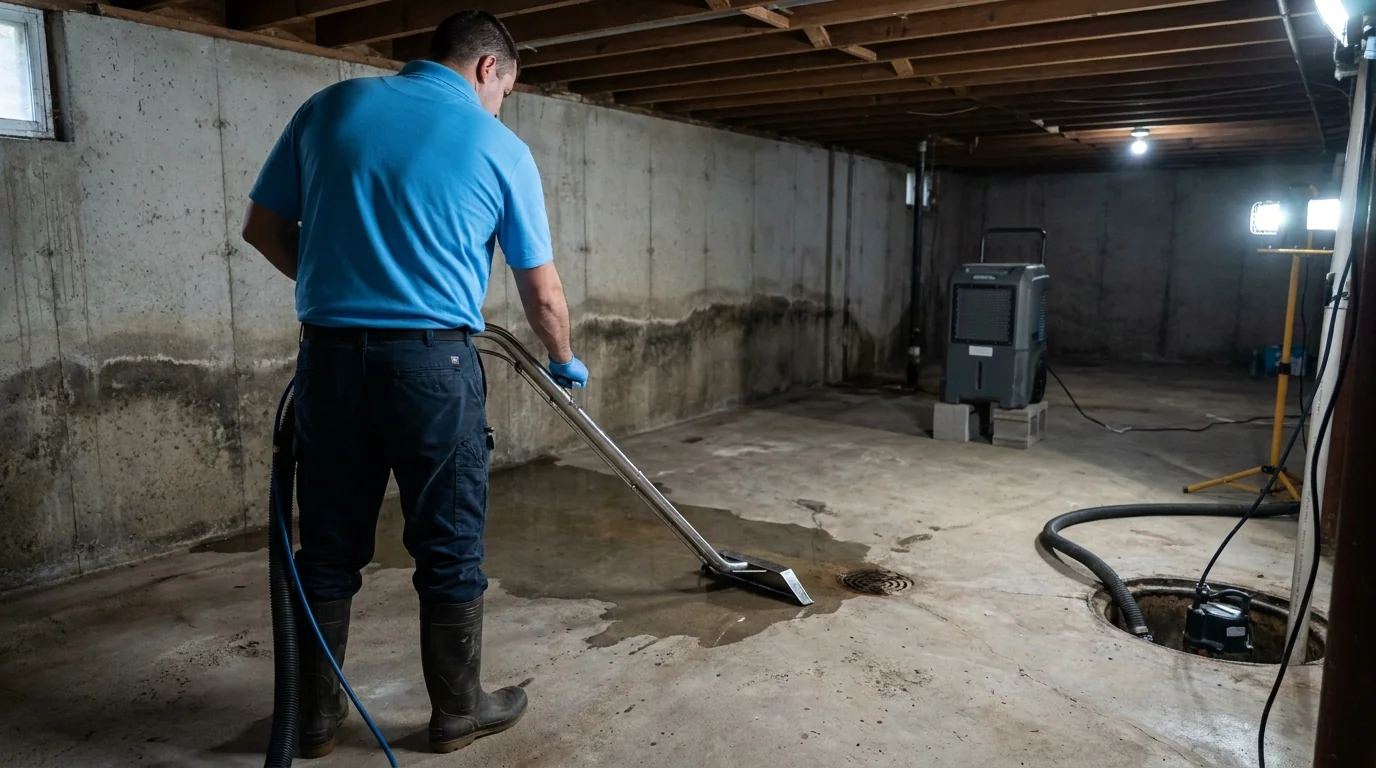
Water extraction comes first. We use truck-mounted and portable extractors to pull bulk water from the floor, then switch to weighted extraction tools to pull water out of carpet and pad before deciding whether those materials can be saved or need to come out.
Structural assessment follows. In Springfield’s older colonials, we pay close attention to concrete block foundations, which absorb water laterally through the mortar joints. We probe walls with moisture meters and thermal imaging cameras to map the full extent of saturation — because water that soaks into a block wall doesn’t announce itself visually.
Controlled demolition, when necessary, means removing wet drywall to the flood cut line, pulling up saturated flooring, and opening cavities so air can reach the framing. We document everything photographically before anything is removed, which matters for your insurance claim.
Drying is calibrated to the actual moisture readings, not a fixed number of days. We deploy commercial-grade desiccant or refrigerant dehumidifiers and high-velocity air movers, repositioning them as readings change. Drying is conducted per the IICRC S500 standard, and we log readings daily so there’s a paper trail showing the structure was returned to pre-loss moisture levels.
Reaching Springfield from Our Kenilworth Base
The Restoration Group’s Kenilworth location puts us minutes from Springfield via Route 22 West — one of the most direct corridors into the township. When Route 22 itself is compromised by flooding (as it was during Ida, when sections near the Route 22 commercial strip turned into a shallow river), our crews can reroute through the Garden State Parkway interchange and approach from the south. We operate 24/7, so a call at 2 a.m. when your sump alarm goes off gets the same response as a call at noon.
Springfield Insurance & Coordination
Most standard homeowner policies in New Jersey distinguish sharply between sewer backup, surface flooding, and sudden discharge from a plumbing failure — and that distinction determines whether your claim is covered and under which endorsement. We document the loss in the format carriers expect: moisture logs, photo evidence of the water intrusion point, affected material inventories, and drying records. We work directly with adjusters and can communicate with your insurer on your behalf to keep the claim moving while you focus on getting your home back in order.
For townhome owners in complexes near the Millburn line, HOA master policies sometimes cover common-area water intrusion but leave unit owners responsible for interior finishes. We’ve navigated that split-coverage situation before and can help you identify which portions of the loss belong to which policy.
Local Note
In Springfield’s pre-war colonials — particularly those on streets that run perpendicular to the Mountain Avenue corridor — many basements were finished with wood furring strips nailed directly to the concrete block wall, then covered with drywall or wood paneling. That air gap between the block and the finish layer can hide weeks’ worth of trapped moisture after a flood. We’ve opened walls in these homes that looked dry on the surface and found active mold growth already underway in the cavity. If your home was built before 1960 and has any wall finish in the basement, we probe behind it before we ever call a job dry.
If your basement is holding water right now — or you’re seeing the waterline on the walls after the fact — call The Restoration Group at (908) 970-8533. We’ll assess the damage, walk you through the process, and get Springfield-area crews moving the same day.
Basement Flooding Cleanup in Springfield: Service Coverage
Frequently Asked Questions
How fast can you arrive for basement flooding cleanup in Springfield?
How quickly can The Restoration Group reach Springfield's Mountain Avenue corridor or Springfield Center after a flooding call?
Springfield has a lot of 1920s–1950s colonials with concrete block foundations — does that change how basement drying works?
Ida turned parts of Route 22 near Springfield into a river — if another major storm floods the township, can you still get to us?
I own a townhome near the Millburn line in Springfield — my HOA has a master policy. How do I know what my insurance covers versus the HOA's policy?
How long does basement drying typically take in a finished Springfield basement after a major flooding event?
Basement Flooding Cleanup response in Springfield
Most Springfield calls see a technician on-site within 60 minutes from our Fair Lawn headquarters.