Flood Damage Restoration in Union
24/7 flood damage restoration in Union, NJ. IICRC-certified, insurance billing accepted. Call (908) 970-8533.
Our IICRC-certified technicians are dispatched from our Fair Lawn, NJ headquarters and are typically on-site in Union within 60 minutes of your call.
When the Elizabeth River tributaries push into low-lying streets off Morris Avenue, or a summer cloudburst turns Vauxhall backyards into retention ponds, the water doesn’t wait for a convenient hour. Union Township’s mix of postwar capes, split-levels, and colonials — most of them built between 1940 and 1965 with finished or semi-finished basements — means a flood event rarely stays on the surface. It soaks into subfloor framing, wicks up drywall, and pools behind the original cast-iron drains that were never designed to handle a 3-inch-per-hour downpour. The Restoration Group operates out of Kenilworth, one town over, and responds 24/7 to flood damage calls across Union’s 07083 and 07088 ZIP codes.
Why Union Properties See Flood Damage So Often
Union Township’s geography works against homeowners in a specific way. The Rahway River watershed sends runoff through town during sustained rain events, and the low corridors near Vauxhall and along Morris Avenue have flooded repeatedly — most memorably during the remnants of Hurricane Ida, when streets that had never taken water before were suddenly under two feet of it. That wasn’t a fluke; it was a preview of what happens when aging storm infrastructure meets increasingly intense rainfall.
Inside the homes, the risk compounds. The dense postwar housing stock throughout neighborhoods like Battle Hill and Union Center carries original galvanized supply lines and cast-iron drain stacks that are now 60 to 80 years old. When those pipes fail — and they fail on a schedule — they fail inside finished basements. Homeowners discover the damage not when the pipe bursts, but hours later when the carpet squishes underfoot or the drywall starts to bubble. By that point, mold colonization can begin within 24 to 48 hours if conditions are warm and humid, which they typically are in a New Jersey summer.
Commercial properties along the Route 22 retail corridor add a different category of loss: sprinkler-system discharges, roof membrane failures, and overnight flooding events that no one finds until a manager opens up in the morning. Kean University’s student housing adds similar late-discovery losses — a slow leak behind a bathroom wall that runs all weekend before anyone notices.
Our Flood Damage Restoration Process in Union
Every job starts with moisture mapping, not assumptions. Technicians use thermal imaging and calibrated moisture meters to trace exactly where water has traveled — because in a 1950s split-level, water that enters at the basement window well can migrate laterally under the slab and show up 20 feet away. We document everything photographically before a single piece of material is moved, which matters for insurance claims.
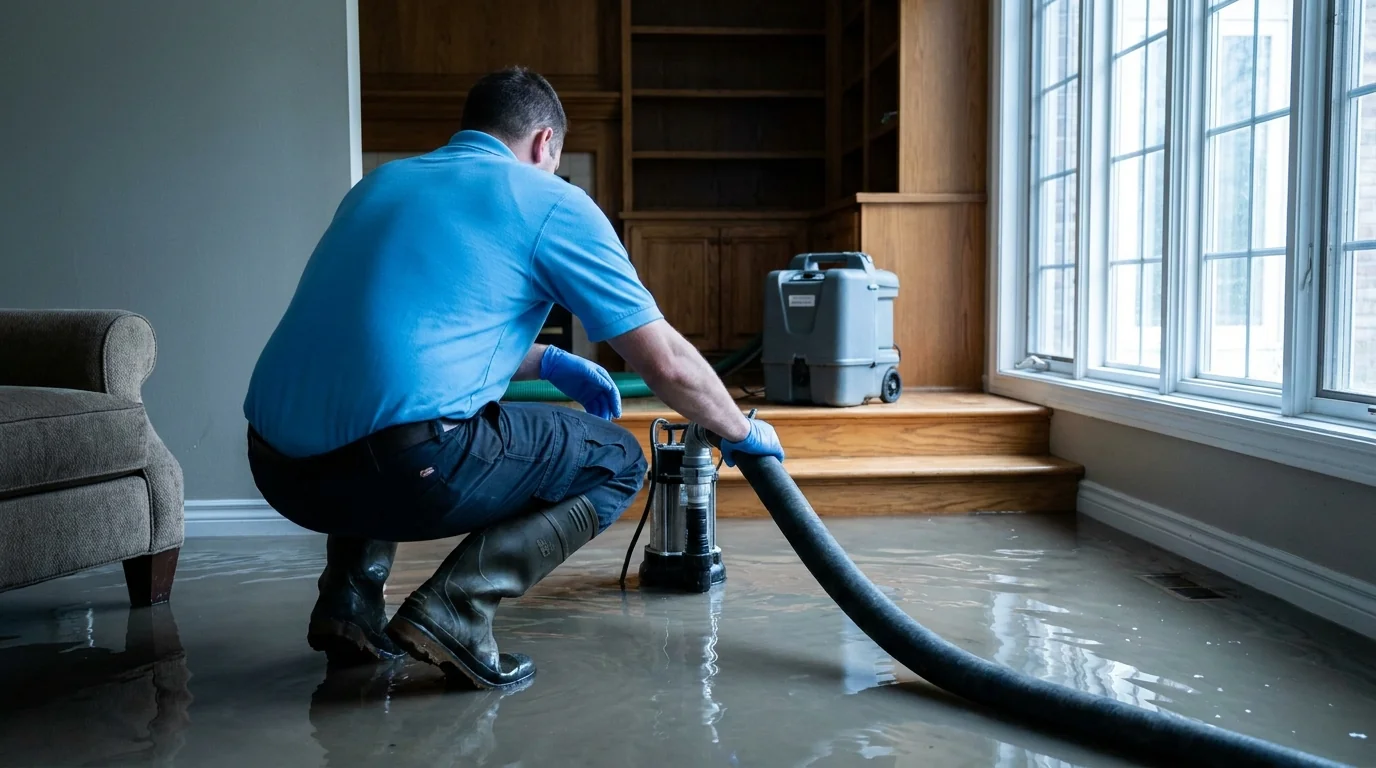
Extraction comes next: truck-mounted and portable units pull standing water from carpet, subfloor, and concrete. Then drying begins in earnest. Industrial desiccant and refrigerant dehumidifiers are positioned to create a controlled drying environment, and air movers accelerate evaporation from structural materials. Moisture readings are logged daily so drying progress is documented, not estimated. Once materials reach target moisture levels per the IICRC S500 standard, the equipment comes out and the rebuild conversation begins — whether that’s replacing drywall, subfloor panels, or insulation that can’t be saved.
Reaching Union from Kenilworth
The Restoration Group’s base in Kenilworth puts crews on Union streets quickly. Kenilworth borders Union directly to the west, and the drive to most Union addresses — whether that’s a basement off Stuyvesant Avenue near the Union Center business district or a split-level in the Putnam Ridge area — is a short run on local roads, not a highway haul from a distant dispatch center. Because hours matter when water is sitting against wood framing, that proximity is a practical advantage, not just a marketing point. We answer calls 24 hours a day, seven days a week, and dispatch is not limited to business hours.
Local Note
One thing crews learn quickly about Union’s postwar split-levels and raised ranches: the half-level below grade is almost always finished with 1960s-era paneling over furring strips, with fiberglass batt insulation tucked behind it. When that assembly floods, the paneling looks fine on the surface for the first 12 to 24 hours while the insulation behind it holds water like a sponge. Homeowners sometimes assume the damage is minimal because nothing looks wet. It rarely is. Thermal imaging on those walls almost always shows a cold, saturated cavity that needs to be opened to dry properly — and the longer it stays closed, the higher the mold risk. If your home in Battle Hill, Larchmont, or anywhere in the 07083 ZIP code has that kind of wall assembly, tell the technician upfront so the inspection starts there.
Insurance Coordination for Union Flood Claims
Flood losses in Union typically run through either standard homeowners policies (for sudden and accidental discharge) or NFIP flood insurance policies for storm-related inundation. The documentation requirements differ, and getting it wrong at the start of a claim can slow payment significantly. The Restoration Group prepares moisture logs, photo documentation, and scope-of-loss reports in formats that major carriers and NFIP adjusters recognize. We work directly with adjusters and can communicate with your carrier on your behalf so you are not translating technical findings into insurance language while also managing a disrupted household.
If your property in Union has flood damage right now, call (908) 970-8533. Crews are available around the clock, the response comes from next-door Kenilworth, and the first step — stopping the damage from getting worse — starts the moment we arrive.
Flood Damage Restoration in Union: Service Coverage
Frequently Asked Questions
How fast can you arrive for flood damage restoration in Union?
How quickly can you reach a home in Vauxhall or the Morris Avenue corridor after a flood call?
Are the postwar split-levels and capes common in Battle Hill and Union Center harder to dry out after a flood?
Does Union Township's storm flooding — like what happened during Ida — get covered differently by insurance than a burst pipe?
How long does flood drying typically take in a finished Union basement?
Do commercial properties along the Route 22 corridor in Union have different restoration requirements than residential jobs?
Flood Damage Restoration response in Union
Most Union calls see a technician on-site within 60 minutes from our Fair Lawn headquarters.