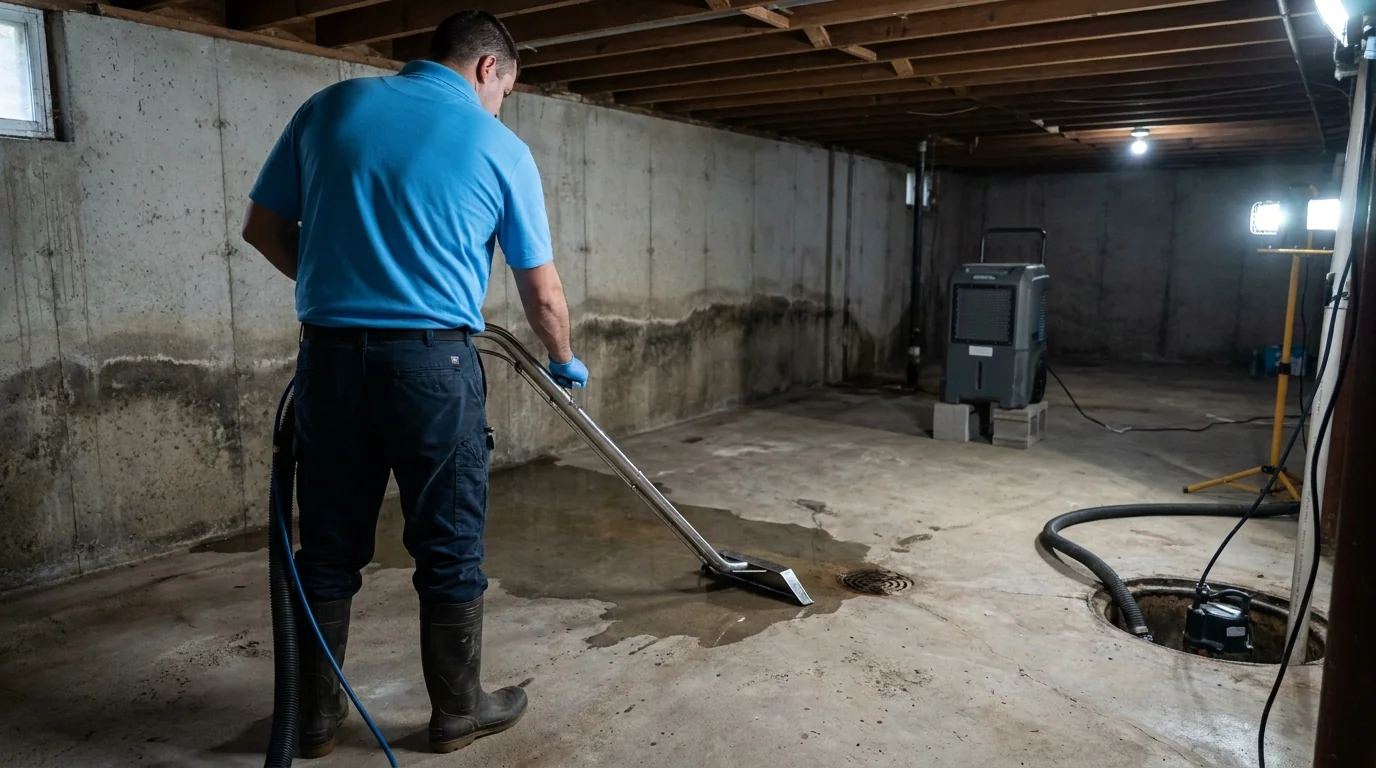
Basement Flooding Cleanup in Manhattan
24/7 basement flooding cleanup in Manhattan, NY. IICRC-certified, insurance billing accepted. Call (908) 970-8533.
Our IICRC-certified technicians are dispatched from our Fair Lawn, NJ headquarters and are typically on-site in Manhattan within 60 minutes of your call.
Manhattan basements flood differently than anywhere else. When a corroded riser lets go inside a pre-war co-op on the Upper West Side, the water doesn’t just pool in one unit — it migrates through original 1920s concrete, saturates the sub-slab fill, and wicks into the brick foundation walls before anyone on the ground floor smells it. Tropical systems like Ida proved that even the city’s upgraded storm drains can’t keep pace with three inches of rain in an hour, leaving basement-level retail and mechanical rooms from Harlem to Chelsea under standing water by midnight. The Restoration Group responds 24/7 — call (908) 970-8533 the moment water appears.
Why Manhattan Properties See Basement Flooding
The island’s geology sets the stage. Manhattan sits on a mix of bedrock and glacial fill, and in low-lying corridors near the East River — think the Lower East Side and the Financial District, ZIP codes 10002 and 10038 — the water table sits close enough to grade that any sustained rainfall or sewer surcharge pushes groundwater through foundation cracks that have been there since the Tammany Hall era. Sandy’s storm surge made this vivid in 2012; Ida repeated the lesson in 2021.
Above grade, the building stock creates its own risks. Pre-war co-ops and postwar rental towers both rely on aging vertical risers — domestic water, steam condensate, sprinkler — that run through every floor. A failed valve or a washing-machine hose on the 14th floor becomes a basement flooding event thirteen stories later, as water follows pipe chases and elevator shafts downward. Newer condo towers in Midtown and Chelsea aren’t immune: high-pressure domestic systems and rooftop mechanical rooms mean failures can be sudden and high-volume.
Our Basement Flooding Cleanup Process in Manhattan
We arrive with truck-mounted extraction equipment capable of pulling hundreds of gallons per hour — necessary when you’re dealing with the volume that accumulates in a commercial basement or a building’s mechanical room. The process moves in deliberate stages:
1. Water removal. Submersible pumps handle standing water first. Wet-vacs and extraction wands follow for residual moisture in carpet, flooring assemblies, and wall cavities.
2. Moisture mapping. Thermal imaging cameras and calibrated moisture meters map how far water has traveled into concrete block, brick, and original plaster. In pre-war buildings, that travel distance is almost always farther than it looks.
3. Structural drying. Industrial desiccant and refrigerant dehumidifiers, paired with high-velocity air movers, dry the structure to IICRC S500 standard. In Manhattan’s dense, low-airflow basements, drying times run longer than in a suburban house — we set realistic timelines rather than optimistic ones.
4. Documentation. Daily moisture logs by unit or zone, timestamped photos, and equipment placement records — the kind of paper trail that resident managers, managing agents, and insurance adjusters all expect.
Navigating Manhattan Buildings as a Restoration Contractor
Working in a Manhattan co-op or condo is not like working in a single-family house. Boards and managing agents require certificates of insurance before we bring equipment into the building. Freight elevator windows are scheduled — often limited to morning hours — and we coordinate those bookings in advance so drying equipment reaches the basement without disrupting residents. If work runs into evening hours, we communicate with the super and the managing agent rather than assuming access.
For commercial clients — the restaurant in Chelsea that loses a prep kitchen to a sewer backup, or the Financial District office suite that takes on water through a below-grade window well — every closed day is direct revenue loss. We sequence our work to restore function to the most critical areas first, then complete structural drying in parallel.
Reaching Manhattan from Kenilworth
The Restoration Group is based in Kenilworth, NJ, and reaches Manhattan via the Lincoln Tunnel or the George Washington Bridge depending on the destination neighborhood. Upper West Side and Harlem jobs typically route through the GWB; Midtown, Chelsea, and Lower East Side jobs come through the Lincoln Tunnel. Because we run 24/7, we can dispatch at hours when tunnel traffic is light and reach most Manhattan neighborhoods faster than during peak commute windows. Call (908) 970-8533 and tell us the address — we’ll give you an honest estimated arrival.
Local Note
One thing that surprises building owners new to Manhattan restoration: the sub-slab fill in many pre-war buildings isn’t compacted gravel — it’s a mix of cinder, ash, and urban debris that was common construction practice before World War II. This material absorbs water like a sponge and releases it slowly over days, which means a basement that looks dry on the surface can still be actively wetting the slab from below. We probe and meter below the slab surface before declaring any Manhattan basement dry, because calling it done too early is how mold colonizes a mechanical room three weeks after the crew leaves.
If you’re dealing with a flooded basement anywhere in Manhattan — from a storm-drain backup in the Lower East Side to a riser failure in a Upper East Side co-op — The Restoration Group is available around the clock. Document what you can, keep people away from standing water near electrical panels, and call (908) 970-8533. We’ll handle the rest.
Basement Flooding Cleanup in Manhattan: Service Coverage
Frequently Asked Questions
How fast can you arrive for basement flooding cleanup in Manhattan?
How quickly can The Restoration Group reach a flooded basement in Midtown or the Upper East Side?
Does our co-op board need to approve restoration work before you can start in a Manhattan building?
Are basements in the Financial District and Lower East Side at higher flood risk than the rest of Manhattan?
How long does basement drying typically take in a Manhattan pre-war building?
Will you handle the insurance documentation that Manhattan adjusters and managing agents require?
Basement Flooding Cleanup response in Manhattan
Most Manhattan calls see a technician on-site within 60 minutes from our Fair Lawn headquarters.