Appliance Leak Cleanup in Newark
24/7 appliance leak cleanup in Newark, NJ. IICRC-certified, insurance billing accepted. Call (908) 970-8533.
Our IICRC-certified technicians are dispatched from our Fair Lawn, NJ headquarters and are typically on-site in Newark within 60 minutes of your call.
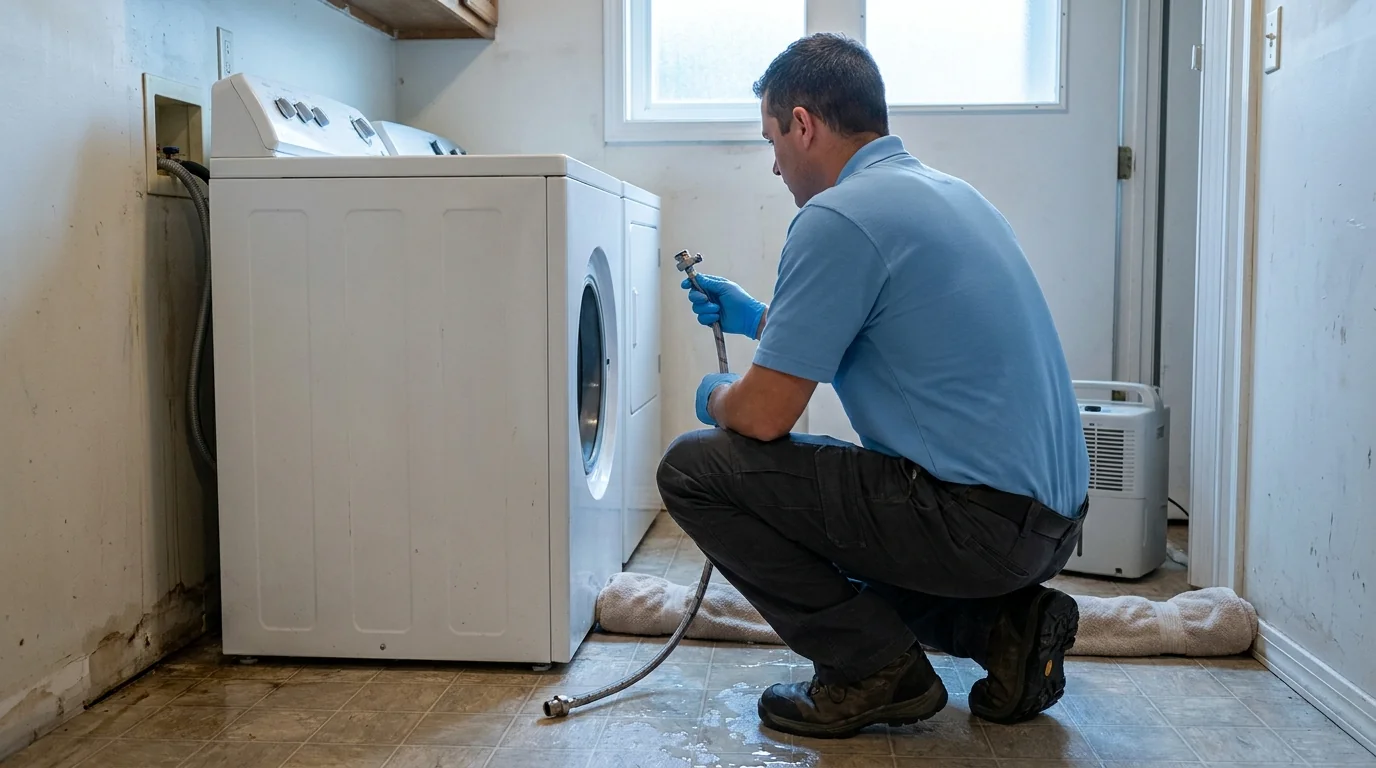
An ice maker line that splits overnight or a washing machine hose that lets go mid-cycle can push dozens of gallons across a floor before anyone notices the sound of water moving where it shouldn’t. In Newark’s dense pre-war housing stock — the brick three-families of the Ironbound, the grand colonials up in Forest Hill, the stacked multifamily buildings near University Heights — that water doesn’t stay on one floor. It follows gravity through subfloor gaps, along plumbing chases, and into the unit below before the upstairs tenant has finished mopping up. The Restoration Group responds 24/7 from Kenilworth, reaching Newark addresses quickly to stop the spread before a contained appliance leak becomes a multi-floor structural claim.
Why Newark Properties See Appliance Leak Damage Differently
Newark’s housing inventory skews heavily toward construction from the 1920s through the 1950s, and that era of building creates conditions that amplify appliance leak damage in ways newer construction doesn’t. Original hardwood subfloors were laid directly over dimensional lumber joists with minimal vapor barrier — water migrates laterally through the wood grain faster than modern OSB sheathing would allow, meaning a refrigerator leak under a kitchen cabinet can saturate ten square feet of subfloor before it ever appears as a ceiling stain in the apartment below.
The city’s combined sewer infrastructure adds a second layer of risk. When heavy rain backs up the system — a recurring problem in low-lying neighborhoods along the Passaic River corridor — a washing machine drain that normally empties freely can reverse-flow during a storm event. What starts as an appliance leak cleanup can quickly involve contaminated water, which changes both the extraction protocol and the disposal requirements under New Jersey DEP guidelines. Knowing the difference matters before the first piece of equipment goes on the floor.
Landlords managing buildings in the 07105 ZIP code and property managers overseeing institutional portfolios near the arena district deal with one additional pressure: documentation. Insurance carriers and building owners both need a clear chain of evidence — moisture readings, affected-area photographs, drying logs — that holds up when multiple tenants are involved in a single loss.
Our Appliance Leak Cleanup Process in Newark
The first priority on any appliance leak call is stopping the water source. That sounds obvious, but in a Newark row building where the main shutoff is in a shared basement accessed through a locked utility corridor, it can take coordination. Our crews arrive with their own water extraction equipment and don’t wait for ideal conditions.
Once the source is controlled, the process follows the IICRC S500 standard for water damage mitigation:
- Moisture mapping — thermal imaging and calibrated moisture meters establish the actual boundary of the wet zone, which in older plaster-and-lath walls is almost always larger than the visible stain.
- Extraction — truck-mounted and portable extractors pull standing water and near-surface saturation from hardwood, tile, and carpet.
- Structural drying — commercial-grade desiccant and refrigerant dehumidifiers, paired with high-velocity air movers, are positioned based on the moisture map, not by guesswork. Readings are logged daily.
- Antimicrobial treatment — applied to any surface where water contact time exceeded 24 hours, consistent with Category 1 water loss protocols.
- Clearance documentation — final moisture readings are recorded and provided in a written report suitable for insurance submission or landlord-tenant dispute resolution.
Reaching Newark from Kenilworth
The shop in Kenilworth sits roughly fifteen minutes from Newark via Route 22 East to McCarter Highway, depending on traffic near the interchange. For calls in the Ironbound or Downtown Newark, the approach through McCarter Highway puts crews close to the Passaic River neighborhoods without routing through the congestion near Newark Penn Station. Forest Hill and Vailsburg addresses on the city’s west side are typically reached via I-78 or South Orange Avenue. Because the team operates around the clock, a call at 2 a.m. about a water heater that failed while the household was asleep gets the same dispatch as a midday dishwasher overflow.
Local Note: Plaster Walls and Hidden Moisture in Newark’s Older Homes
One thing that catches out-of-market contractors in Newark’s pre-war buildings: plaster-and-lath walls hold moisture in a way that drywall simply doesn’t. When a refrigerator leak or dishwasher overflow saturates the base of a plaster wall, the material wicks water upward through capillary action and then releases it slowly — sometimes over eight to twelve days rather than the three to five days typical for gypsum drywall. Crews who set drying equipment based on drywall timelines and pull it too early will leave residual moisture behind the plaster face, where it sits undisturbed long enough for mold colonization to begin. The Restoration Group’s drying protocols account for this: moisture readings in plaster assemblies are held to a stricter threshold before equipment is removed, and final documentation reflects the extended drying window so there’s no ambiguity in the insurance file.
Newark Insurance Coordination
Most standard homeowner and renter policies cover sudden appliance leaks — a dishwasher supply line failure, an ice maker connection that pulls loose — but carriers distinguish sharply between sudden loss and gradual leakage. A slow drip under a refrigerator that has been staining the floor for months is typically denied; a washing machine hose that fails and floods a laundry room in an afternoon is typically covered. The Restoration Group documents the loss in a format that supports the sudden-loss narrative where the facts support it: timestamped photographs, moisture readings on arrival, and a written scope of work that maps affected materials to the source event. For landlords managing multiple units in a Newark building, that documentation also serves as the record for tenant communication and any subsequent repair permitting required by the city.
If you are dealing with an appliance leak in Newark right now — whether it’s a dishwasher overflow in an Ironbound two-family or a water heater failure in a Forest Hill colonial — call (908) 970-8533. The crew is dispatched around the clock, and the documentation starts the moment they arrive.
Appliance Leak Cleanup in Newark: Service Coverage
Frequently Asked Questions
How fast can you arrive for appliance leak cleanup in Newark?
How quickly can The Restoration Group reach the Ironbound or Downtown Newark for an appliance leak emergency?
Are Newark's older pre-war buildings harder to dry out after a washing machine flood or dishwasher leak?
Can a washing machine drain backup during a Newark rainstorm turn an appliance leak into a sewage cleanup?
What documentation does The Restoration Group provide for a multi-unit Newark building where an appliance leak affected more than one floor?
Does a refrigerator ice maker line leak in a Newark ZIP code like 07105 typically qualify as a covered insurance loss?
Appliance Leak Cleanup response in Newark
Most Newark calls see a technician on-site within 60 minutes from our Fair Lawn headquarters.