Basement Flooding Cleanup in Newark
24/7 basement flooding cleanup in Newark, NJ. IICRC-certified, insurance billing accepted. Call (908) 970-8533.
Our IICRC-certified technicians are dispatched from our Fair Lawn, NJ headquarters and are typically on-site in Newark within 60 minutes of your call.
When the Passaic River swells after a nor’easter or a summer cloudburst hammers Newark’s aging combined sewer system, basements across the Ironbound and Weequahic fill faster than a sump pump can cycle. The Restoration Group is on call around the clock from our Kenilworth shop — roughly fifteen minutes up McCarter Highway — to extract standing water, dry structural materials, and document everything your insurance carrier needs before secondary damage sets in.
Why Newark Properties See Basement Flooding So Often
Newark’s infrastructure tells the story. Much of the city sits on low-lying ground, and the combined sewer system — one pipe carrying both stormwater and sanitary waste — backs up into basement floor drains during heavy rainfall. That means a flooded basement in the Ironbound or along the flats near Newark Penn Station often isn’t clean water. It’s Category 3 sewage contamination, which requires a different response than a burst supply line: full personal protective equipment, antimicrobial treatment of every affected surface, and proper disposal of porous materials that can’t be safely dried in place.
The housing stock compounds the problem. Newark is dense with pre-war brick multifamily buildings, frame two- and three-families, and the grand colonials of Forest Hill — most of them built before modern waterproofing standards existed. Basement walls are often uncoated block or brick, mortar joints long since compromised, and drainage tile (if it exists at all) may be clay pipe from the 1920s. When one riser fails in a three-story building, water follows gravity through every floor assembly on the way down. Landlords and property managers in ZIP codes like 07105 and 07106 know this pattern well.
Our Basement Flooding Cleanup Process in Newark
The first thing we do on arrival is assess the water category and source. If sewage is involved — common in the low-lying blocks east of Branch Brook Park — we contain the area and suit up accordingly before any extraction begins. That step protects your household and our crew, and it determines what materials can be salvaged versus what must go.
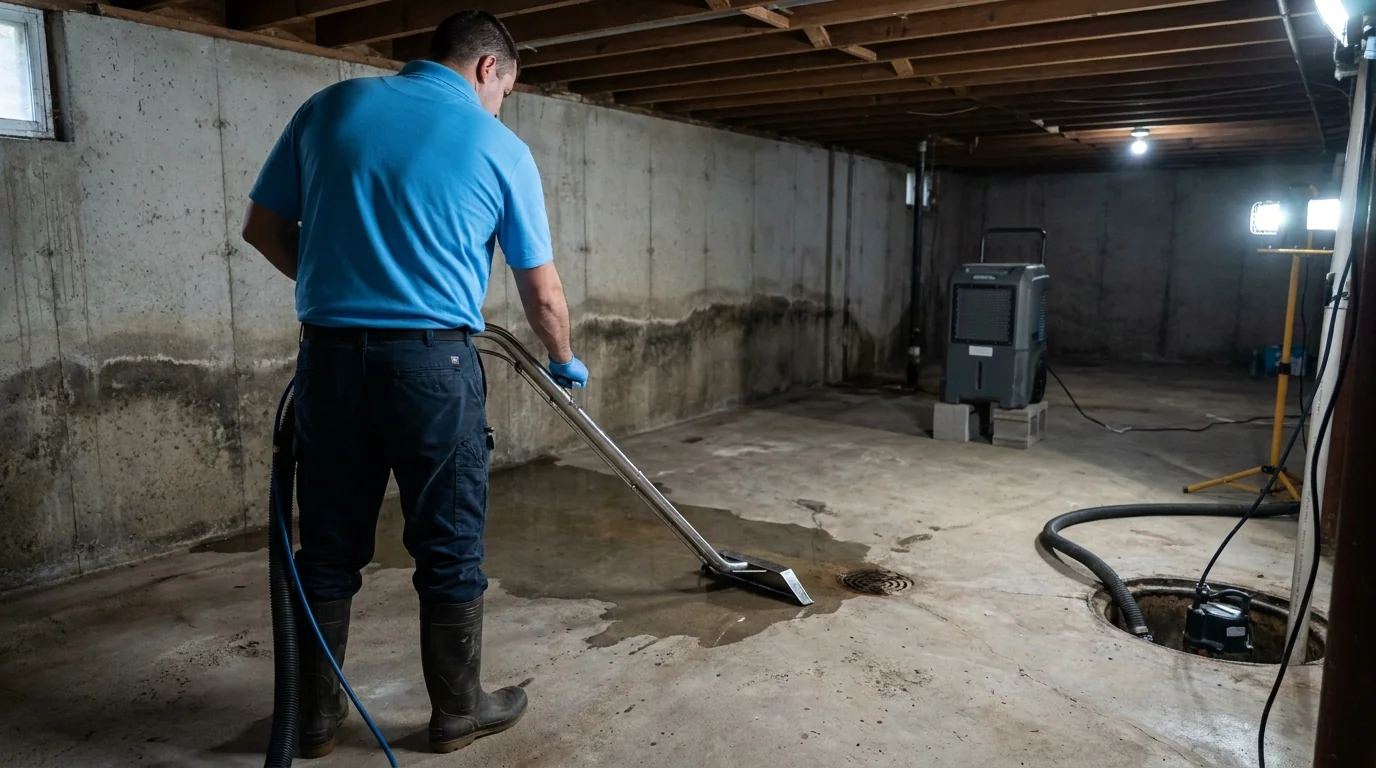
Once the source is confirmed and controlled, we deploy truck-mounted or portable extraction units to pull standing water from the floor, then transition to commercial-grade desiccant dehumidifiers and high-velocity air movers calibrated to the square footage and construction type. In Newark’s older block-wall basements, we often run equipment longer than we would in a newer poured-concrete foundation — block is porous and holds moisture in its cores, and our moisture meters guide us to the actual dry standard rather than a guessed timeline.
We photograph and document every step: water levels, moisture readings, equipment placement, and material conditions. That documentation package is what makes the difference when your adjuster reviews the claim.
Reaching Newark from Kenilworth
Kenilworth sits just off Route 22, and our crews travel McCarter Highway (Route 21) directly into Newark around the clock. The Ironbound — ZIP 07105 — is typically our first stop on the eastern side of the city. Forest Hill, Vailsburg, and University Heights are accessible via I-78 or Springfield Avenue depending on traffic. Because we operate 24/7, we dispatch on your call regardless of hour, and we stay on-site until extraction is complete and drying equipment is running — we don’t drop off machines and disappear.
Newark Insurance Coordination
Newark’s landlord and property-manager community deals with insurance claims constantly, and we’ve built our documentation process around what adjusters actually need to approve a mitigation claim. We record moisture readings at intake and at each daily check, photograph affected materials before and after removal, and produce a written scope that maps to standard line items. We bill most major carriers directly, which keeps you from fronting restoration costs while you’re already dealing with a displaced tenant or a shut-down unit.
If your property is in a flood-prone area near the Passaic River corridor, your adjuster may ask for elevation certificates or prior loss history — we can flag that early in the process so it doesn’t stall your claim.
Local Note
In Newark’s Ironbound neighborhood, many basement floors are original poured concrete from the early 1900s — uneven, sometimes cracked, and sitting directly on fill soil with no vapor barrier underneath. After extraction, moisture wicks back up through those cracks from the saturated ground below, and a crew that packs up equipment after one dry reading will leave a damp basement that grows mold within 48 to 72 hours. We run daily moisture checks and keep dehumidifiers in place until sub-slab readings stabilize, not just surface readings — a distinction that matters a great deal in this neighborhood’s building stock.
If your Newark basement flooded — whether it’s a sewer backup on a rainy Tuesday or a burst pipe in the middle of the night — call The Restoration Group at (908) 970-8533. We’re IICRC Certified (Firm #210213), licensed by the NJ Division of Consumer Affairs as a Home Improvement Contractor, and dispatching from Kenilworth every hour of the day.
Basement Flooding Cleanup in Newark: Service Coverage
Frequently Asked Questions
How fast can you arrive for basement flooding cleanup in Newark?
How quickly can The Restoration Group reach the Ironbound after a basement flooding call?
Newark's combined sewers back up into basements — does that change how you clean up the water?
Are Forest Hill's older colonial homes more difficult to dry after a basement flood?
What ZIP codes in Newark do you serve for basement water removal?
How long does basement drying typically take in Newark's pre-war building stock?
Will my homeowners insurance cover basement flooding cleanup in Newark?
Basement Flooding Cleanup response in Newark
Most Newark calls see a technician on-site within 60 minutes from our Fair Lawn headquarters.